Last updated 2026-07-23
TL;DR
Starting a NEMT business means forming a legal entity, getting a wheelchair-accessible or ambulatory van insured commercially, passing state vehicle/driver inspections, enrolling as a Medicaid transportation provider (or subcontracting through a broker like Modivcare or MTM), and completing broker credentialing. Most solo operators spend 2 to 6 months on paperwork before their first paid trip, and requirements vary a lot by state.
What is non-emergency medical transportation (NEMT)?
Non-emergency medical transportation, usually shortened to NEMT, is transportation to and from medical appointments for people who don't need an ambulance but can't drive themselves or use regular transit. Think dialysis three times a week, chemo infusions, physical therapy, or a wheelchair user going to a primary care visit. It's not a 911 response and it's not a hospital transfer between facilities in an emergency. Federal Medicaid rules require states to make sure eligible people can get to and from covered medical care, and NEMT is the mechanism for that. The Code of Federal Regulations at 42 CFR 431.53 requires state Medicaid plans to "specify that the Medicaid agency will ensure necessary transportation for beneficiaries to and from providers" [1]. States meet that obligation either by running the transportation program directly, paying transportation providers directly, or contracting with a transportation broker who manages a network of drivers and vans. Most states now use the broker model. Modivcare, MTM, Access2Care, and SafeRide are the big national names, though a state might use a regional broker or run things in-house instead. If you're new to this, read up on nemt and non emergency medical transportation basics before you spend money on a vehicle.
How do you start a medical transportation business?
At a high level, starting a medical transportation business means stacking five things in roughly this order: business entity and licensing, a compliant vehicle, insurance, state Medicaid enrollment, and broker credentialing. Skip a step or do them out of order and you'll end up buying insurance twice or failing an inspection because you didn't know the wheelchair lift needed a specific tie-down standard. Here's the realistic sequence: 1. Form an LLC or corporation and get an EIN from the IRS. 2. Get your state NEMT operating authority or permit, if your state requires one (many do, some route it through the Department of Transportation, others through Health and Human Services). 3. Buy or lease a vehicle that meets ADA and state accessibility standards if you're doing wheelchair transport. 4. Get commercial auto insurance with the right liability limits for livery/NEMT use, not a personal or standard commercial policy. 5. Pass vehicle inspection and driver background checks (fingerprinting, MVR pull, drug screen are common). 6. Enroll as a Medicaid transportation provider with your state Medicaid agency, or apply to become a subcontracted provider with the regional broker. 7. Complete broker credentialing (separate from state enrollment) including vehicle photos, insurance certificates, and driver files. 8. Get trip-dispatch software or at least a reliable way to receive and log trips. Every state Medicaid agency runs its own transportation unit or delegates to a broker, so the exact door you walk through differs. Confirm the process with your broker and state Medicaid agency before committing money, because some states require state enrollment first and others let the broker onboard you and handle Medicaid billing behind the scenes.
How to start a NEMT business with one van
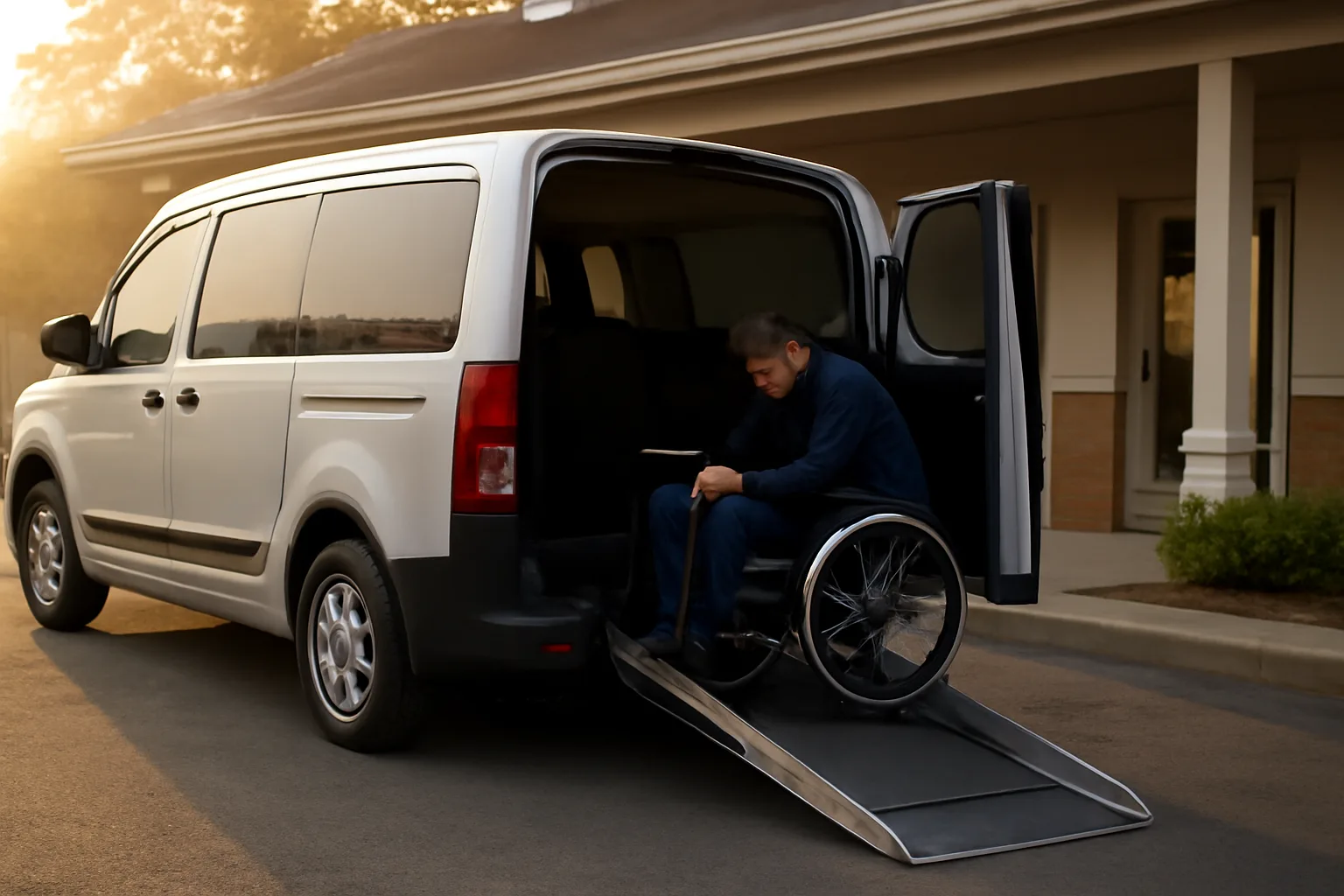
You can start with a single wheelchair-accessible van. Plenty of owner-operators do exactly that. The math and the paperwork don't get lighter just because you're a fleet of one, though; you still need the entity, the insurance, the enrollment, and the credentialing. A few things matter more when you're a one-van shop: Vehicle choice. A used wheelchair van (Dodge Grand Caravan, Toyota Sienna, or Ford Transit conversions are common) with a working ramp or lift, tie-downs rated for the weight, and low enough mileage to pass inspection reliably. Conversions run anywhere from about $25,000 to $60,000+ for a newer used unit, though prices swing hard by region and mileage; get any used conversion inspected by a mobility dealer before you buy, not after. Insurance is the line item that surprises new owner-operators most. A personal auto policy won't cover paid passenger transport, and a standard commercial policy might not meet broker minimums (many brokers require $1,000,000 combined single limit liability, sometimes more, plus specific wheelchair lift/ramp coverage). Get quotes before you buy the van, not after, so you know your real monthly cost. Driver-owner qualification. If you're driving your own van, you still go through the same background check, drug screen, and defensive driving/passenger assistance training that any driver would. Some states require a specific NEMT driver certification or a CPR/First Aid card. One van means one point of failure. If your van is in the shop, you have zero capacity that day. Brokers know this and some are hesitant to lean on single-vehicle providers for high-volume routes. That's not a reason to avoid starting small, it's just something to plan around: keep a maintenance fund and a backup driver arrangement if you can.
What licenses and permits does a NEMT business actually need?
| Business entity (LLC/corp) + EIN | Secretary of State + IRS | Needed before almost anything else | |
|---|---|---|---|
| NEMT operator permit or certificate | State DOT or state Medicaid agency | Not every state requires a separate NEMT permit | |
| Vehicle inspection (annual or biannual) | State DOT or DMV | Often includes lift/ramp/tie-down check | |
| Commercial driver requirements | State DMV | CDL usually not required for a van under 15 passengers, but confirm | |
| Driver background check + drug screening | State Medicaid agency or broker | Fingerprint-based checks common | |
| Medicaid provider enrollment (NPI, provider agreement) | State Medicaid agency | Required to bill Medicaid directly | |
| Broker credentialing packet | Broker (Modivcare, MTM, Access2Care, SafeRide, or regional) | Separate from state enrollment | |
| Commercial auto insurance meeting broker minimums | Insurance carrier | Confirm exact limits with broker | Federal regulation makes clear that non-emergency medical transportation is generally a mandatory benefit under the Medicaid state plan, but implementation, provider enrollment steps, and the broker relationship are all set at the state level [1]. That's why two states next to each other can have completely different onboarding timelines. Always confirm the current list with your state Medicaid transportation unit directly, since these requirements get updated and this article can't track fifty states in real time. |
The exact list depends entirely on your state, which is the honest, if unsatisfying, answer. But most states ask for some combination of the following. | Requirement | Typical source | Notes |
How does Medicaid NEMT provider enrollment work?
Enrolling as a Medicaid NEMT provider usually means applying through your state's Medicaid provider enrollment portal (many use a system built on MMIS, the Medicaid Management Information System) and getting a National Provider Identifier (NPI) from the National Plan and Provider Enumeration System, which is free and takes about 10 business days online. After you submit the provider application, the state Medicaid agency reviews your business license, vehicle documentation, insurance certificates, and driver credentials. Processing time varies a lot: some states move in a few weeks, others take two to three months, especially if your application is missing a document and it has to cycle back through review. Build in buffer time and don't sign a vehicle loan assuming you'll be moving patients in 30 days. In most states now, once you're state-enrolled you still need to separately credential with whichever broker manages NEMT trips in your region. State enrollment establishes you as a legitimate Medicaid provider; broker credentialing is what actually gets trips routed to you. Some states reverse this order and require broker approval before state enrollment finalizes. Confirm the sequence with your broker and state Medicaid agency, because guessing wrong here wastes weeks. For background on how the state layer works generally, see medical transportation and nemt transportation.
How does broker credentialing work with Modivcare, MTM, Access2Care, or SafeRide?
Broker credentialing is the process a transportation broker uses to vet you before routing Medicaid trips to your vehicles. It runs alongside, not instead of, state Medicaid enrollment in most states. While each broker's exact packet differs, the common elements are: - Business documents: entity formation, EIN, business license.
- Vehicle documents: registration, title or lease, current inspection certificate, photos of the interior and exterior, wheelchair lift/ramp certification if applicable.
- Insurance: certificate of insurance naming the broker as certificate holder in some cases, meeting the broker's minimum liability limits.
- Driver files: background check results, MVR (motor vehicle record), drug test results, defensive driving certificate, passenger assistance training, sometimes a specific NEMT driver orientation the broker itself runs.
- Ongoing compliance: many brokers re-verify insurance and driver files annually, and some do random vehicle inspections. Modivcare, MTM, Access2Care, and SafeRide each run their own portal and their own timeline, and none of them are affiliated with this article or with each other's requirements. A broker in one state may want a $1,000,000 CSL policy; the same broker in a different state contract might set a different floor. Don't assume last year's requirement or another state's requirement still applies. Call the broker's provider relations line and ask for the current credentialing checklist in writing. This two-track system (state enrollment plus broker credentialing) is the single biggest source of confusion for new owner-operators, and it's the reason so many first-timers underestimate their launch timeline by a month or two.
Does Medicaid cover ambulance rides?
Yes, Medicaid covers ambulance transportation when it's medically necessary, but that's a different benefit than NEMT. Ambulance services (emergency or non-emergency ground and air ambulance) are billed and covered separately from the wheelchair-van and ambulatory NEMT trips this article is about. Ambulance transport is used when a person's medical condition requires medical monitoring or a stretcher during the ride, or when it's a true emergency. NEMT, by contrast, covers people who need a ride but not medical care during transit, like a dialysis patient who can sit in a wheelchair-accessible van seat. Federal Medicaid regulations at 42 CFR 440.170 define "transportation" as a Medicaid service covering ambulance, non-emergency, and other means of transport, treating them as related but distinct service types states must define in their state plans [2]. If you're building a business specifically around ambulance-level transport, you're looking at a different licensing path entirely (EMT/paramedic certification, state EMS agency licensing, and generally much higher insurance and equipment requirements). That's a separate business, not an NEMT wheelchair-van operation. Read more on the distinction at emergency medical transport.
Does Medicare cover medical transportation?
Medicare's coverage of medical transportation is narrower than Medicaid's. Original Medicare (Part B) covers ambulance transportation when other transportation could endanger your health, and generally only to the nearest appropriate facility that can provide the care you need [3]. Medicare does not have a broad non-emergency medical transportation benefit the way Medicaid does. Some Medicare Advantage (Part C) plans offer NEMT as a supplemental benefit, meaning a private Medicare Advantage insurer chooses to cover rides to routine appointments as an extra perk beyond what Original Medicare requires. Coverage, ride limits, and the network of approved transportation providers vary plan by plan and are set by the individual insurer, not by CMS directly. If you're building your NEMT business, this matters for one practical reason: your main and most reliable payer relationship is almost always going to be Medicaid through your state agency or its broker, not Medicare. Some Medicare Advantage plans do contract with the same regional brokers (Modivcare and MTM both run Medicare Advantage NEMT networks in various states), so once you're credentialed with a broker, you may pick up Medicare Advantage trips too. But don't build your business plan around Medicare fee-for-service; it's just not the same kind of benefit.
How much does it cost to start a NEMT business?
Costs vary enormously by state, vehicle condition, and whether you're leasing or buying, so treat any number here as a range, not a quote. Rough categories to budget for: - Business formation and licensing: usually a few hundred dollars for LLC filing fees, plus any state NEMT permit fee (some states charge nothing, others charge several hundred dollars).
- Vehicle: a used wheelchair-accessible conversion van typically runs from the mid-$20,000s to $60,000+ depending on age, mileage, and lift type. A standard ambulatory sedan or minivan without a lift costs much less.
- Commercial insurance: NEMT commercial auto policies commonly run from a few thousand dollars a year up into five figures annually, driven heavily by your state, driving record, and whether you're covering wheelchair lift liability.
- Driver background checks, drug screening, and required training courses: often a few hundred dollars per driver.
- Dispatch software or a trip-management tool: monthly SaaS fees, ranging from free/manual tracking to a few hundred dollars a month for fleet software, depending on your volume.
- Working capital: Medicaid and broker payment cycles are not instant. Many brokers pay on a two-week or monthly cycle, so you need cash reserves to cover fuel, insurance, and driver pay before your first payments land. None of this includes projected revenue or trip volume, because that's determined entirely by the trip volume your broker actually routes to you, which nobody can promise in advance. Anyone quoting you guaranteed trip numbers before you're even credentialed should be treated with real skepticism.
What paperwork slows down NEMT approval the most?
Three things consistently stall new NEMT applications, according to the pattern most state provider-enrollment guidance pages warn about repeatedly: incomplete insurance documentation, mismatched vehicle information between the registration and the inspection report, and missing driver background check results. Insurance certificates that don't name the correct entity, don't meet the minimum liability limit, or don't include wheelchair lift/ramp endorsement language get kicked back constantly. Get your insurance agent to confirm, in writing, that the policy meets your state's and your target broker's specific minimums before you submit anything. Vehicle documentation mismatches happen when a van's VIN, seating capacity, or lift certification on the registration doesn't match what's on the inspection sticker or the broker's vehicle photo requirements. Double check every document lines up before you submit the packet. Driver files with gaps (an old drug screen, a background check from the wrong vendor, missing MVR) are the third big stall point. If you're the owner-driver, don't assume you're exempt from any of this just because it's your own van; in almost every state you go through the same driver credentialing as an employee would. A well-organized submission packet, with every document current and cross-checked, is genuinely the difference between a 3-week approval and a 3-month one. This is exactly the kind of paperwork organization tool the RideCredential Launch Kit ($199 one-time, at /launch-kit-builder) was built around: state-specific and broker-specific checklists so you're not guessing what's missing.
Should you go through a broker or enroll directly with Medicaid?
In most states today you don't fully get to choose; the broker model is how the state runs its NEMT program, so becoming a broker-network provider is the practical path to Medicaid trips even though you may also need direct state enrollment as a Medicaid provider. A minority of states still run more of the program in-house or allow direct billing for certain trip types, so this genuinely depends on where you operate. The practical difference for you as an owner-operator: broker-network providers get trips dispatched to them through the broker's software and get paid by the broker (who in turn is paid by the state). Direct Medicaid billing, where it still exists, means you submit claims straight to the state Medicaid agency using your NPI and provider agreement, with no broker in the middle. Most new owner-operators end up doing both: state Medicaid enrollment to be a legitimate, billable provider, and broker credentialing with whichever of Modivcare, MTM, Access2Care, SafeRide, or a regional broker manages your area's Medicaid transportation contract. Ask your state Medicaid transportation unit directly which model applies where you plan to operate, and get it in writing before you buy a van assuming a particular payment path.
Frequently asked questions
What is non-emergency medical transportation (NEMT)?
NEMT is transportation to and from covered medical appointments for people who don't need an ambulance but can't get there on their own, such as dialysis, therapy, or routine doctor visits. States must ensure this transportation is available under federal Medicaid rules at 42 CFR 431.53, usually through direct provider payment or a transportation broker.
How do I start a medical transportation business from scratch?
Form a legal business entity, get any required state NEMT permit, buy or lease a compliant vehicle, secure commercial auto insurance meeting broker minimums, pass driver background checks and vehicle inspection, enroll as a Medicaid provider with your state, and complete separate credentialing with your regional broker (Modivcare, MTM, Access2Care, SafeRide, or another).
Can I start a NEMT business with just one van?
Yes. Single-vehicle owner-operators are common in NEMT. You still need the full entity, insurance, inspection, state enrollment, and broker credentialing process; one van just means less redundancy if that vehicle is out of service, so budget for maintenance downtime and a backup plan.
Does Medicaid cover ambulance rides?
Yes, Medicaid covers medically necessary ambulance transportation, but it's a separate benefit category from NEMT. Ambulance transport applies when a patient needs medical monitoring or a stretcher during the ride or is in a true emergency; NEMT covers people who need a ride but not medical care in transit.
Does Medicare cover non-emergency medical transportation?
Original Medicare Part B mainly covers ambulance transportation when other transport would endanger the patient's health, not routine non-emergency rides. Some Medicare Advantage plans offer NEMT as a supplemental benefit, but coverage and networks vary by plan and insurer, not by a uniform federal rule.
What licenses do I need to start a NEMT business?
Typically an LLC or corporation with an EIN, a state NEMT operating permit if your state requires one, vehicle inspection certification, driver background checks and drug screening, Medicaid provider enrollment with an NPI, and separate broker credentialing. The exact list varies by state; confirm with your state Medicaid transportation unit.
How long does NEMT Medicaid enrollment take?
It varies widely, from a few weeks in some states to two or three months in others, especially if paperwork is incomplete on first submission. Broker credentialing runs as a separate process and can add more time. Confirm current timelines directly with your state Medicaid agency and target broker before committing to a launch date.
Do I need broker credentialing if I'm already Medicaid-enrolled?
In most states, yes. State Medicaid enrollment makes you a legitimate, billable provider, but broker credentialing (with Modivcare, MTM, Access2Care, SafeRide, or a regional broker) is usually the separate process that actually gets trips dispatched to your vehicle. Ask your state which model it uses before assuming one covers the other.
What kind of vehicle do I need for NEMT?
It depends on the trip types you plan to serve. Ambulatory transport can use a standard sedan or minivan. Wheelchair transport requires a van with a certified ramp or lift and properly rated tie-downs meeting ADA and state accessibility standards. Get any used conversion inspected by a mobility dealer before buying it.
How much insurance do I need for an NEMT business?
Personal auto insurance and most standard commercial policies won't cover paid passenger transport. NEMT businesses need commercial auto coverage meeting the state's and broker's minimum liability limits, which commonly reach $1,000,000 combined single limit or more, plus specific coverage for wheelchair lift or ramp use. Confirm exact limits with your broker.
What's the difference between NEMT and ambulance transport?
NEMT serves people who need a ride to medical care but don't need medical monitoring during the trip, using wheelchair vans or ambulatory vehicles. Ambulance transport is for patients who need medical care or monitoring in transit, or true emergencies, and requires EMT/paramedic staffing and separate state EMS licensing.
Can an owner-operator drive their own NEMT van?
Yes, and it's common for single-vehicle businesses. The owner-driver still needs to complete the same background check, drug screening, and any required training (defensive driving, passenger assistance, CPR/First Aid) that an employed driver would go through under state and broker rules.
How do NEMT brokers like Modivcare, MTM, Access2Care, and SafeRide differ?
Each broker manages Medicaid transportation networks under separate state contracts, with its own credentialing portal, documentation checklist, insurance minimums, and dispatch software. None are affiliated with each other. Requirements can differ by state even for the same broker, so always get the current checklist directly from the broker's provider relations team.
Sources
- eCFR, 42 CFR 431.53 (Assurance of transportation): Federal Medicaid regulation requires states to ensure necessary transportation for beneficiaries to and from providers
- eCFR, 42 CFR 440.170 (Transportation): Federal Medicaid regulations define transportation as a covered service including ambulance and non-emergency transport, as distinct service types
- Medicare.gov, Ambulance Services coverage: Medicare Part B covers ambulance transportation when other transportation would endanger health, generally to the nearest appropriate facility
- CMS, Medicaid Management Information System (MMIS) overview: States use MMIS-based systems for Medicaid provider enrollment applications
- 42 U.S.C. 1396a, Social Security Act Section 1902(a)(4): State Medicaid plans must provide methods of administration necessary for proper and efficient operation, the statutory basis underlying the transportation assurance requirement