Last updated 2026-07-25
TL;DR
To start a medical transportation business, you form a legal entity, get a wheelchair-accessible or ambulatory vehicle meeting your state's specs, secure commercial auto and general liability insurance, enroll as a Medicaid transportation provider with your state agency, then credential with brokers like Modivcare or MTM. Most owner-operators start with one van before adding drivers or vehicles.
How do you start a medical transportation business?
You start a non-emergency medical transportation (NEMT) business by stacking five things in order: a legal business entity, the right vehicle, insurance that matches your state's minimums, state Medicaid provider enrollment, and broker credentialing. Skip a step and you'll get stuck later, usually at the credentialing stage when a broker asks for a document you don't have. Most new owner-operators form an LLC first (cheap, usually $50 to $500 depending on the state, and it separates your personal assets from business liability). Then they buy or convert a wheelchair-accessible van, because that's the vehicle type Medicaid programs need most and it opens more trip categories than an ambulatory-only sedan. After the entity and vehicle, you line up commercial auto insurance and general liability coverage. Then you apply for a Medicaid provider number through your state's Medicaid agency, not through a broker. Only after you have that provider number do you apply to become a subcontracted transportation network provider with the broker or brokers your state uses. The order matters because brokers require an active state Medicaid enrollment before they'll even open your credentialing file in most states. Confirm the exact sequence with your broker and state Medicaid agency, since a few states let broker credentialing run in parallel with enrollment. For background on how the whole system fits together, see medical transportation and nemt.
What is NEMT (non-emergency medical transportation)?
NEMT is transportation to and from covered medical appointments for people who don't need an ambulance but can't get there on their own, usually because of a disability, a wheelchair, or a lack of any other transportation option. It's a distinct Medicaid benefit from ambulance transport and it's the category almost every new owner-operator in this space enters. Federal Medicaid regulation requires states to "ensure necessary transportation for recipients to and from providers" and to describe in their state plan how they meet that requirement, per 42 CFR 431.53 [1]. States implement this differently: some run NEMT in-house, some contract with a single statewide broker, and some use regional brokers. That's why the credentialing paperwork looks completely different in Ohio versus Texas versus Florida. NEMT covers a wide span of trip types: ambulatory sedan trips, wheelchair van trips, stretcher van trips, and in some states, non-emergency ambulance trips for patients who need medical monitoring but aren't in a 911 situation. Wheelchair van work tends to pay a higher per-trip rate than ambulatory sedan work because the vehicle and lift equipment cost more to operate and maintain. See non emergency medical transportation and non emergency medical transportation services for more on how trip types and state programs differ.
Does Medicaid cover ambulance rides?
Yes. Medicaid covers ambulance transportation when a beneficiary's condition requires it, but ambulance service is billed and regulated separately from NEMT and usually requires a different license entirely (EMT/paramedic staffing, emergency vehicle permitting). CMS describes ambulance services as covered when "transportation by any other means would endanger the beneficiary's health" [2]. If you're planning a wheelchair-van NEMT business, you generally do not need ambulance licensure or EMT certification, because NEMT vehicles carry passengers who don't need medical monitoring in transit. Don't confuse the two credentialing paths. A state EMS office regulates ambulance licensing; the state Medicaid agency (often through a broker) regulates NEMT enrollment. Confirm with your state Medicaid agency which office handles which application, because in a few states the same office touches both.
Does Medicare cover medical transportation?
Medicare covers ambulance transportation under Medicare Part B when it's medically necessary and other transportation could endanger the patient's health, per CMS's ambulance services coverage rules [3]. Medicare's coverage of routine non-emergency wheelchair-van rides is much narrower than Medicaid's. Medicare Part B can cover non-emergency ambulance transportation for a beneficiary with a written order from a doctor stating it's medically necessary, most commonly for dialysis patients who need repeat non-emergency ambulance trips. But Medicare does not generally pay for standard NEMT wheelchair-van rides to a routine doctor's appointment the way Medicaid does. Some Medicare Advantage plans offer NEMT as a supplemental benefit, which is a separate contracting relationship from either fee-for-service Medicare or Medicaid, and those contracts are negotiated plan by plan. If you want steady work, Medicaid NEMT and Medicare Advantage supplemental transportation are the two realistic revenue paths for a new wheelchair-van operator. Traditional fee-for-service Medicare NEMT work is rare.
How do I register my NEMT business (entity, EIN, licensing)?
Register your NEMT business by forming a legal entity (LLC is standard for owner-operators), getting a federal EIN from the IRS at no cost, registering for state and local business licenses, and getting any state-specific transportation permits your state requires. The entity step is quick: most Secretary of State websites process LLC filings online in one to two weeks, and the EIN application through the IRS is free and instant online [4]. Don't pay a third-party site for an EIN. It's a federal form, always free. After the entity, check whether your state requires a separate for-hire or livery vehicle permit, a Certificate of Public Convenience and Necessity, or a specific NEMT operator license issued by the state Department of Transportation or state Medicaid transportation unit. Requirements vary widely: some states require none of this beyond the Medicaid enrollment itself, others layer on a state PUC (Public Utilities Commission) permit for any vehicle transporting passengers for a fee. Budget real time for this stage. Entity formation is fast. Permit and license research is the part that eats weeks if you don't start early.
What vehicle do I need to start (and can I start with one van)?
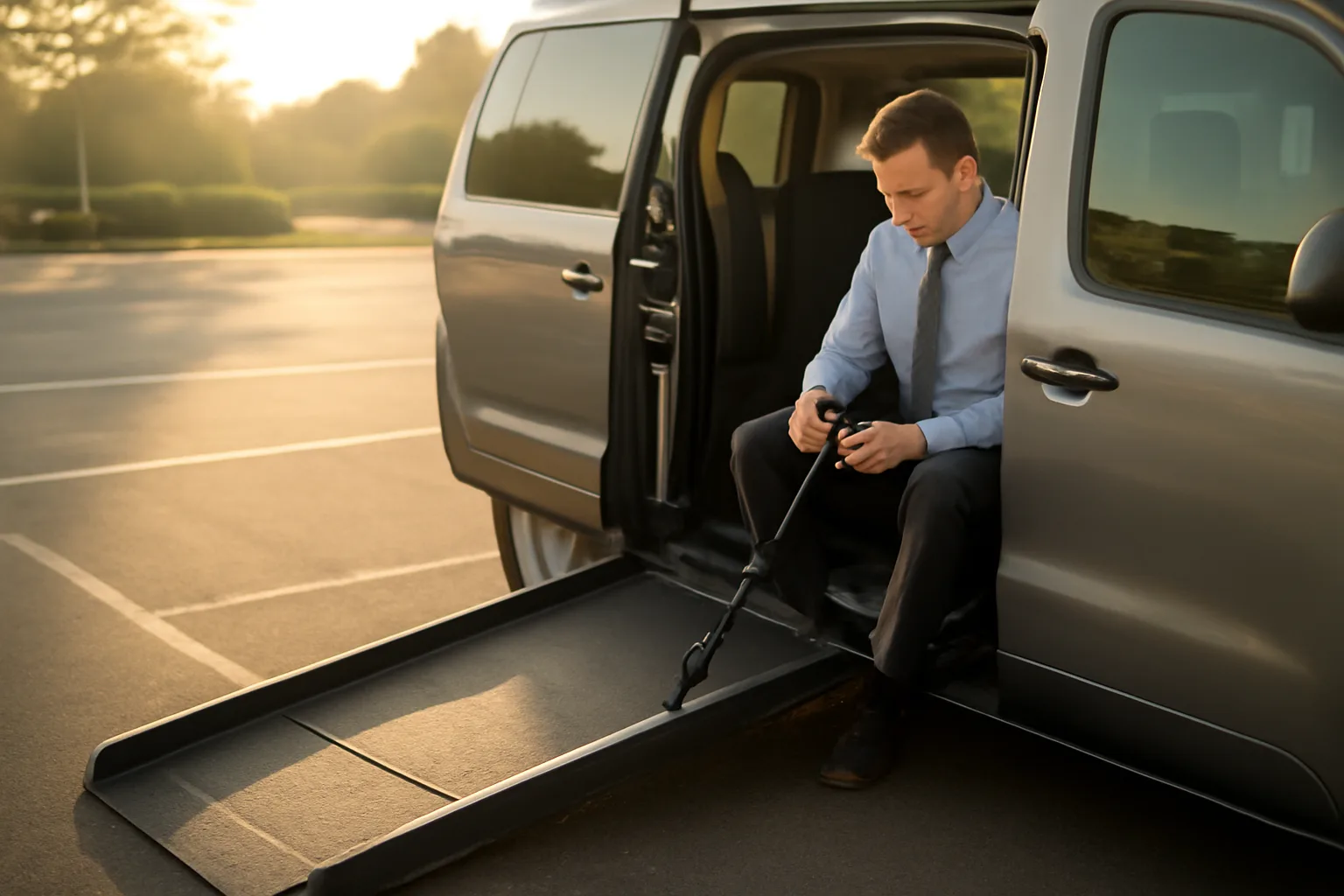
Yes, you can start a medical transportation business with one van, and most owner-operators do exactly that. The vehicle needs to meet your state's accessibility and safety specs, which typically means a wheelchair lift or ramp, secured tie-down points for the wheelchair, and passage of a state vehicle inspection specific to NEMT or paratransit vehicles. Many states and brokers require the wheelchair-accessible vehicle to comply with Americans with Disabilities Act (ADA) design guidance for vehicle-mounted lifts and securement systems, and some states additionally require compliance with Federal Motor Vehicle Safety Standard 222 (school bus/multi-passenger seating standards) for larger conversion vans, though requirements differ by state and vehicle size. Confirm the exact spec sheet with your state Medicaid agency and the broker you plan to credential with, since inspection checklists differ broker to broker. One van is enough to get your first Medicaid provider number and your first broker credential. Adding a second or third vehicle later means repeating parts of the inspection and insurance process for each vehicle, but it does not usually mean re-doing your entire enrollment from scratch. Keep your maintenance and inspection records organized from day one. Every broker audit we've heard operators describe starts with a request for vehicle maintenance logs. For a broader look at vehicle types and specs across NEMT and higher-acuity transport, see nemt-transportation and emergency-medical-transport.
What insurance do I need before I can enroll or credential?
You need commercial auto liability insurance that meets or exceeds your state's minimum for passenger-for-hire vehicles, plus general liability coverage, before most states or brokers will finish processing your application. Many states and brokers require limits well above a standard personal auto policy, commonly in the $1,000,000 combined single limit range for wheelchair-van operators, though the exact figure is set by your state Medicaid agency or broker contract and must be confirmed directly. Some states also require workers' compensation coverage once you hire your first driver, even part-time. If you're driving solo as the sole owner-operator with no employees, some states exempt you, but this varies enough that you should check your specific state's workers' comp statute rather than assume either way. Get insurance quotes before you sign anything with a broker. Underwriters who specialize in NEMT and paratransit fleets exist and often quote faster and cheaper than general commercial auto carriers unfamiliar with wheelchair-van work, because they already understand the lift equipment and passenger-assist risk profile.
How do I enroll as a Medicaid transportation provider?
You enroll as a Medicaid transportation provider by applying directly through your state Medicaid agency's provider enrollment portal or transportation unit, submitting your entity documents, EIN, vehicle and driver information, and insurance certificates, then waiting for a provider number to be issued. CMS requires state Medicaid agencies to screen and enroll providers under standards set out in 42 CFR Part 455, including provider screening and disclosure requirements [5]. Every state runs its own portal and paperwork, so "how long does it take" and "what exact documents" both come down to confirming with your specific state Medicaid agency's transportation or provider enrollment unit. A few things are close to universal: you'll need your entity's EIN, your NPI (National Provider Identifier) if your state requires one for transportation providers, proof of insurance, vehicle registration and inspection documents, and background check clearance for every driver. Background check standards for Medicaid providers are shaped by federal screening rules under 42 CFR 455.434 on the fingerprint-based background check requirements for certain provider categories [6], though states vary in whether NEMT providers fall into a category requiring fingerprinting versus a standard background check. Don't submit an incomplete application hoping to fix it later. Most state portals reject or indefinitely pause incomplete files rather than following up, and reapplying can cost you another full review cycle.
How do I get credentialed with Modivcare, MTM, Access2Care, or SafeRide?
You get credentialed with a NEMT broker by applying directly through that broker's transportation provider portal after your state Medicaid enrollment is active, then completing their vehicle inspection, driver background check, and insurance verification steps before they'll dispatch trips to you. Modivcare, MTM, Access2Care, and SafeRide each run their own separate credentialing process even within the same state, and a state can use more than one broker for different regions or program types. None of these companies are affiliated with each other or with any single national standard, so a document accepted by one broker won't automatically transfer to another. Expect each broker to ask for: your Medicaid provider number, vehicle registration and inspection results, proof of insurance naming required limits, driver background checks and often drug screening, and a signed subcontractor or network provider agreement. Some brokers also require a defensive driving course completion or passenger assistance training certificate for every driver before activation. Credentialing timelines vary broker to broker and region to region, and no broker publishes a guaranteed turnaround time. Confirm current timelines and document lists directly with the broker in your state, since these processes change without much public notice. If you want a structured way to track every document across your state enrollment and broker credentialing, that's the exact gap the $199 one-time Launch Kit Builder was built to close, it's a checklist and document tracker, not a guarantee of approval.
What does it cost to start a NEMT business with one van?
Startup cost for a one-van NEMT business swings widely depending on whether you buy new or used, convert the vehicle yourself or buy it pre-converted, and what your state and insurer require. There's no single honest number here; treat any site that gives you one flat figure with suspicion. Rough cost buckets to budget for: a used wheelchair-accessible conversion van (commonly in the tens of thousands of dollars depending on age, mileage, and lift condition), commercial auto and general liability insurance premiums, LLC formation and any state permit fees, background check and drug screening costs per driver, and any broker-required training courses. Because these figures depend entirely on your state, your vehicle choice, and your insurer, get real quotes for your specific situation rather than budgeting off a number you saw online. What's more predictable is the paperwork cost: entity formation, EIN, and provider enrollment applications themselves are typically free or low-cost (the IRS EIN is free, LLC filing fees run roughly $50 to $500 depending on the state). The real money goes to the vehicle and insurance, not the government paperwork.
What's the realistic order of operations, start to finish?
| Step | What you do | Who you deal with | |
|---|---|---|---|
| 1 | Form your LLC and get an EIN | Secretary of State, IRS | |
| 2 | Buy or convert a wheelchair van meeting state specs | Vehicle seller/converter, state inspector | |
| 3 | Get commercial auto and general liability insurance | NEMT-specialty insurance broker | |
| 4 | Apply for state licenses/permits if required | State DOT or PUC | |
| 5 | Enroll as a Medicaid transportation provider | State Medicaid agency | |
| 6 | Apply for broker credentialing | Modivcare, MTM, Access2Care, SafeRide, etc. | |
| 7 | Complete driver background checks and training | Broker/state requirements | |
| 8 | Get activated and start receiving dispatched trips | Broker dispatch system | This order isn't legally mandated everywhere, but skipping ahead almost always backfires. Brokers routinely won't open a credentialing file without an active state Medicaid provider number in hand, and states won't finish enrollment without proof of insurance and a passing vehicle inspection. Do the steps in sequence and you'll avoid resubmitting the same documents twice. |
What mistakes do new owner-operators make most often?
The most common mistake is buying the vehicle before checking the state's exact accessibility and inspection specs, then finding out the lift or tie-down system doesn't pass inspection. Get your state's vehicle spec sheet before you buy, not after. Second most common: assuming broker credentialing and state Medicaid enrollment are the same process. They're not. You need both, and they're handled by completely different offices with completely different document requirements. Third: underestimating insurance costs and timelines. NEMT-specific commercial policies take real underwriting time, sometimes weeks, and premiums for wheelchair-van coverage run higher than a standard commercial auto quote because of the passenger-assist liability. Get quotes early, not after your vehicle is sitting ready to go. Fourth: not keeping a driver and vehicle document file from day one. Every renewal, every broker audit, every new broker relationship down the road asks for the same core documents. Keep them organized in one place and you'll save yourself hours every year.
Frequently asked questions
How do I start a medical transportation business?
Form a legal entity, buy a vehicle that meets your state's accessibility and inspection specs, get commercial auto and general liability insurance, enroll as a Medicaid provider through your state Medicaid agency, then apply for broker credentialing (Modivcare, MTM, Access2Care, SafeRide, or whichever brokers serve your state). Confirm exact sequencing and document lists with your state Medicaid agency and broker.
How do you start a NEMT business specifically?
NEMT (non-emergency medical transportation) businesses follow the same core steps as general medical transportation startups: entity formation, a compliant wheelchair or ambulatory vehicle, insurance, state Medicaid enrollment, and broker credentialing. NEMT doesn't require EMT licensure or ambulance permitting, which is what separates it from emergency ambulance transport businesses.
What is NEMT?
NEMT stands for non-emergency medical transportation, a Medicaid benefit that gets beneficiaries to and from covered medical appointments when they can't drive themselves and don't need an ambulance. States must ensure this transportation is available under 42 CFR 431.53, though each state designs its own delivery system, often through contracted brokers.
Does Medicaid cover ambulance rides?
Yes, Medicaid covers ambulance transportation when a beneficiary's medical condition requires it, meaning other transportation would endanger their health. Ambulance service is billed and regulated separately from NEMT wheelchair-van transport and generally requires EMT staffing and a separate state EMS licensing process, not standard NEMT credentialing.
Does Medicare cover medical transportation?
Medicare Part B covers ambulance transportation when medically necessary, including some non-emergency ambulance trips with a doctor's written order (common for dialysis patients). Medicare generally does not cover routine wheelchair-van NEMT rides the way Medicaid does, though some Medicare Advantage plans offer supplemental transportation benefits under separate plan contracts.
What is non-emergency medical transportation?
Non-emergency medical transportation is transportation to and from Medicaid-covered medical appointments for people who need help getting there, whether due to a wheelchair, a disability, or lack of any other transportation option, but who don't require ambulance-level medical monitoring during the ride.
How do I start a medical transportation business with one van?
One van is enough to launch. Get it inspected against your state's NEMT vehicle spec, insure it at your state's or broker's required commercial limits, enroll as a Medicaid provider, then apply for broker credentialing. You can add vehicles and drivers later without redoing your full state enrollment in most states.
How much does it cost to start a wheelchair van NEMT business?
There's no single honest flat number. Costs depend heavily on whether you buy new or used, convert the van yourself, and what your state and insurer require. The largest costs are typically the vehicle itself and commercial insurance premiums; entity formation and EIN registration are comparatively cheap or free.
Do I need an EMT license to run a wheelchair van NEMT business?
Generally no. NEMT wheelchair-van transport carries passengers who don't need medical monitoring in transit, so it doesn't require EMT certification or ambulance licensure. Ambulance transport is a separate credentialing path through your state's EMS office. Confirm with your state Medicaid agency which category your specific service falls under.
What's the difference between state Medicaid enrollment and broker credentialing?
State Medicaid enrollment gives you a provider number directly from your state Medicaid agency and is usually required first. Broker credentialing is a separate process with companies like Modivcare, MTM, Access2Care, or SafeRide that dispatch trips on the state's behalf, and each broker has its own document requirements and portal.
How long does NEMT broker credentialing take?
No broker publishes a guaranteed timeline, and it varies by broker and region. It depends on how quickly you submit complete documentation (vehicle inspection, insurance, driver background checks) and how backed up the broker's credentialing team is. Confirm current expected timelines directly with the broker you're applying to.
Can I run a medical transportation business without contracting with a broker?
In some states yes, if the state Medicaid agency dispatches trips directly rather than through a broker, or if you also pursue private-pay and Medicare Advantage transportation contracts outside Medicaid entirely. But in most states using a broker model, broker credentialing is the main path to receiving Medicaid-funded trip dispatches.
Sources
- eCFR, 42 CFR 431.53: States must ensure necessary transportation for Medicaid recipients to and from providers
- CMS, Medicare Benefit Policy Manual Chapter 10 (Ambulance Services): Ambulance services are covered when transportation by other means would endanger the beneficiary's health
- Medicare.gov, Ambulance Services coverage: Medicare Part B covers ambulance transportation when medically necessary
- IRS, Apply for an Employer Identification Number (EIN) Online: EIN applications through the IRS are free and processed online
- eCFR, 42 CFR Part 455: CMS sets provider screening and enrollment standards states must follow for Medicaid providers
- eCFR, 42 CFR 455.434: Federal rule requires fingerprint-based background checks for certain Medicaid provider categories
- Medicaid.gov, Non-Emergency Medical Transportation: NEMT is a Medicaid benefit ensuring transportation to covered medical services