Last updated 2026-07-25
TL;DR
The NAICS code most NEMT businesses use is 621910 (Ambulance Services), which the Census Bureau defines to include ambulatory transport of patients without medical care aboard. Some wheelchair-van-only operations use 485991 (Special Needs Transportation) instead. Your state Medicaid enrollment form or SAM.gov registration will tell you which one applies to your business type.
what is the NAICS code for non-emergency medical transportation
The code you'll use most often is 621910, Ambulance Services. The North American Industry Classification System (NAICS) is the federal standard used by the Census Bureau, IRS, SBA, and most state agencies to classify what a business actually does. Here's the part that trips people up: 621910 sits under the health care sector, not transportation. The Census Bureau's own definition covers establishments primarily engaged in providing transportation of patients by ground or air, along with medical care, and it also lists this class as including transport 'without medical care' when that's the nature of the business. That second clause is the one that matters for wheelchair-van and ambulatory NEMT operators. You're not running an ambulance with paramedics. You're running scheduled, non-emergency rides, and the code still applies. A second code shows up in some state and federal filings: 485991, Special Needs Transportation. This class covers ground passenger transportation, primarily to the elderly and persons with disabilities, that is not medically necessary and not part of urban transit systems. Some wheelchair-van-only businesses, especially those that never bill Medicaid as a medical service and instead run private-pay ambulatory rides, register under this code instead. Neither code is wrong on its face. Which one you pick usually depends on how your state Medicaid agency, your broker, or your bank classifies the work when you fill out enrollment paperwork.
which NAICS code should a wheelchair van business actually use
If you're enrolling as a Medicaid NEMT transportation provider or contracting with a broker like Modivcare, MTM, Access2Care, or SafeRide, use 621910. That's the code state Medicaid transportation units and CMS systems generally expect to see tied to NEMT provider enrollment, because it sits in the health services classification family alongside ambulance and paratransit medical transport. If your business is strictly private-pay wheelchair transport with no Medicaid billing at all, some accountants and business registration services will point you to 485991 instead, since it's explicitly a passenger transportation code rather than a health services one. Honest answer: there's no single federal rule that forces one over the other for NEMT specifically. NAICS codes are self-selected on most business registration forms, and the code mainly affects things like industry benchmarking, SBA loan classification, and sometimes state tax treatment. When in doubt, use 621910 on your state Medicaid provider enrollment application, then confirm with your state Medicaid agency's transportation unit and your broker's credentialing packet whether they want a specific code listed anywhere. Some state provider enrollment portals ask for it directly; others never mention NAICS at all.
what is NEMT
NEMT stands for non-emergency medical transportation. It's transportation to and from medical appointments, dialysis, therapy, or pharmacy visits for people who don't need an ambulance but can't drive themselves or use regular transit. Riders typically use wheelchairs, walkers, or have a condition that makes standard transportation unsafe or unworkable. Federal Medicaid rules require states to ensure 'necessary transportation for recipients to and from providers' as a condition of the Medicaid state plan, per 42 CFR 431.53 [1]. States meet that obligation in different ways: some run NEMT in-house through county or state agencies, most contract it out to a transportation broker who then subcontracts to local NEMT providers like wheelchair-van and ambulatory transport companies. That's the business model most owner-operators are stepping into: not billing Medicaid directly in many states, but getting credentialed with the broker who holds the state contract, then getting trip assignments through that broker's dispatch system. Learn more about how nemt and non emergency medical transportation programs are structured state by state.
does medicaid cover ambulance rides
Yes, Medicaid covers emergency ambulance transportation in every state, since it's a mandatory benefit tied to medical necessity. What varies enormously is coverage for non-emergency ambulance and non-emergency medical transportation more broadly, because states have real discretion in how they design their NEMT benefit under federal guidance [1]. Medicaid.gov describes NEMT as a required benefit that ensures beneficiaries without transportation access can still get to Medicaid-covered services, calling it something states 'must ensure' as part of assuring transportation to and from providers [2]. That's a broader statement than "Medicaid pays for ambulances," and it's the legal hook that funds wheelchair-van and ambulatory NEMT rides, more than ambulance runs. So to directly answer it: does Medicaid cover ambulance rides? Emergency ambulance, generally yes, nationwide. Non-emergency ambulance and non-ambulance NEMT (wheelchair van, ambulatory sedan) rides, yes in the sense that federal rule requires access to transportation, but the specific coverage rules, prior authorization requirements, and vehicle types allowed are set state by state. Confirm with your state Medicaid agency for the specifics that apply where you operate.
does medicare cover medical transportation
Medicare's coverage of non-emergency transportation is much narrower than Medicaid's. Original Medicare covers non-emergency ambulance transportation only when it's medically necessary and a written order from a doctor confirms that other transportation would endanger the patient's health, per CMS guidance on ambulance services [3]. Medicare generally does not cover routine wheelchair-van rides to a dialysis appointment or a doctor visit just because a rider can't drive. That's a common point of confusion for new owner-operators: your Medicaid NEMT contract with a broker is a completely different payer relationship than Medicare, and Medicare Advantage plans are a third, separate lane, since some Medicare Advantage plans now offer supplemental transportation benefits as an extra plan feature rather than a standard Medicare entitlement [3]. If you're building a business plan around Medicare Advantage transportation benefits, that's typically a separate contracting relationship with the specific MA plan or its vendor, not something covered by your state Medicaid broker credentialing.
how to start a nemt business
Here's the realistic order of operations, stripped of fluff: 1. Register your business entity (LLC is standard) with your state. 2. Get a federal EIN from the IRS. 3. Pick your NAICS code, typically 621910. 4. Buy or lease a wheelchair-accessible van that meets your state's vehicle inspection and ADA-related accessibility standards. 5. Get commercial auto insurance with the liability limits your state and broker require (often $1 million combined single limit, but confirm with your state and broker). 6. Complete any required driver background checks, drug screening, and defensive-driving or passenger-assistance training your state mandates. 7. Apply for state Medicaid NEMT provider enrollment, or apply directly to the broker if your state uses a broker model. 8. Pass any required vehicle inspection and credentialing review from the broker (Modivcare, MTM, Access2Care, SafeRide, or your state's contracted broker). 9. Start taking dispatched trips. Most of the actual delay in this process isn't step 4, buying the van. It's steps 6 through 8, background checks and credentialing paperwork, which can take anywhere from a few weeks to a few months depending on your state's backlog and the broker's review queue. Confirm current timelines with your broker and state Medicaid agency before you commit to a launch date.
how do you start a medical transportation business
This is the same process as starting a NEMT business specifically, described above, but it's worth separating two different business models people mean when they say "medical transportation business." One is non-emergency ground transport (NEMT): wheelchair vans, ambulatory sedans, stretcher vans. This is the segment most new owner-operators enter, since it doesn't require paramedic-level clinical licensure and the vehicle and insurance requirements are lower than for ambulances. The other is licensed ambulance service (BLS/ALS), which requires state EMS licensure, certified EMTs or paramedics on board, and a much heavier regulatory and clinical compliance load. If your plan is one van and a couple of contractors, you almost certainly want the NEMT path, not ambulance licensure. Check your medical transportation options and how NEMT differs from licensed ambulance work before you buy equipment.
how to start a medical transportation business with one van
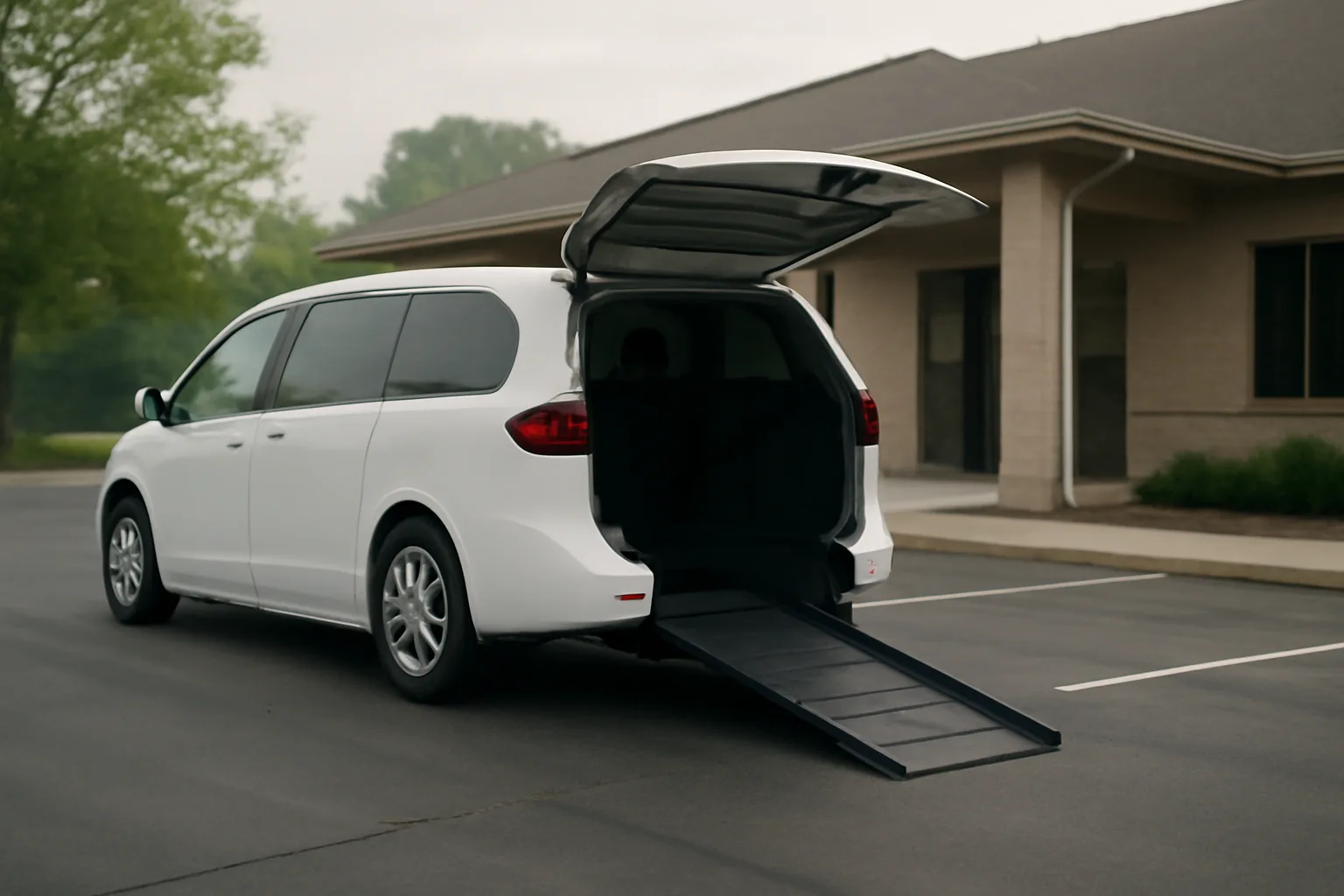
One van is a completely normal way to start. Most owner-operators in this industry begin with a single wheelchair-accessible minivan or full-size van, not a fleet. The practical checklist for a one-van start: - Confirm your state's minimum insurance and vehicle inspection requirements before you buy, not after. Some states require specific ADA lift or ramp specs, wheelchair securement systems (commonly required to meet standards referenced by WC19 crash-tested securement, though exact requirements vary by state), and annual safety inspections.
- Decide whether you'll drive the van yourself or hire a driver from day one. Owner-operator-drives is the lower-overhead starting structure.
- Apply to your state Medicaid program and to the broker(s) covering your county at the same time, since credentialing timelines run in parallel, not sequentially, in most states.
- Don't buy a second van until your first one is generating consistent dispatched trips and you understand your local broker's trip volume and payment cadence firsthand. A single van won't get you exclusivity in any territory, brokers typically credential many providers per county, but it's enough to get through your first credentialing cycle and learn the actual operational rhythm (dispatch software, no-show policies, mileage reimbursement rates) before you scale.
how to start a non-emergency medical transportation business step by step
| Step | What it involves | Typical timing | |
|---|---|---|---|
| Entity formation (LLC) | State filing, EIN | 1-2 weeks | |
| Vehicle purchase/lease | ADA-compliant wheelchair van | Varies | |
| Commercial insurance | Liability limits per state/broker | 1-2 weeks to bind | |
| Driver requirements | Background check, drug screen, training | 2-6 weeks | |
| State Medicaid provider enrollment | Application, NPI (if required), site visit | 4-12 weeks, confirm with your state | |
| Broker credentialing | Modivcare/MTM/Access2Care/SafeRide application, vehicle inspection | 2-8 weeks, confirm with broker | |
| First dispatched trip | Once both state and broker approvals are complete | N/A | These ranges are general patterns, not guarantees. Every state Medicaid transportation unit runs its own enrollment timeline and paperwork, and every broker has its own credentialing checklist and vehicle inspection standard. Confirm specifics directly with your state Medicaid agency and the broker(s) operating in your service area before you assume any of these timelines apply to you. For a state-by-state look at how enrollment differs, see non emergency medical transportation and non emergency medical transportation services. |
why does the NAICS code actually matter for a new NEMT owner-operator
Three concrete places it shows up. First, SBA loan and grant applications often ask for your NAICS code to determine size standards and eligible industries; ambulance services (621910) and specialty passenger transportation have separate small business size standards under SBA's table of size standards [4]. Second, some state and local business licensing offices use NAICS to route your application to the correct department, so picking the wrong one can bounce your license application back for correction. Third, workers' comp and commercial insurance underwriters sometimes use NAICS-adjacent industry classification to price risk, though insurers typically rely on their own classification codes (like those from NCCI) rather than NAICS directly. None of this is make-or-break. Getting the NAICS code wrong on a form usually means a correction request, not a denial. But picking 621910 from the start saves you a round trip on state licensing paperwork and matches what most Medicaid provider enrollment systems expect to see. If you're assembling your state Medicaid application and broker credentialing paperwork together, a State + Broker NEMT Launch Kit ($199, one-time, see /launch-kit-builder) can save you from hunting down which code goes on which form state by state, though you can absolutely compile this yourself directly from your state Medicaid transportation unit's published provider enrollment packet.
what other classification codes come up for NEMT businesses
Beyond NAICS, you may run into a few other coding systems: - SIC code 4119 (Local Passenger Transportation, NEC) is the older Standard Industrial Classification system's rough equivalent, still requested by some legacy state forms and older insurance underwriting systems.
- NPI (National Provider Identifier) is not a classification code at all, it's an individual/organizational identifier issued by CMS's National Plan and Provider Enumeration System, and many states require NEMT providers to obtain one for Medicaid billing purposes.
- Taxonomy codes, specifically Healthcare Provider Taxonomy Code 343900000X (Transportation, Non-emergency, associated with Medicaid provider enrollment) may be requested alongside your NPI when you enroll with your state Medicaid agency [5]. Don't confuse these. NAICS classifies your industry for census, tax, and licensing purposes. NPI identifies you as a specific health care provider entity. Taxonomy codes describe your specific service type within the NPI system. State Medicaid enrollment portals frequently ask for two or three of these on the same application, so keep them straight when you're filling out paperwork.
Frequently asked questions
What is the NAICS code for non-emergency medical transportation?
Most NEMT businesses use 621910, Ambulance Services, which the Census Bureau's NAICS definition includes for patient transport with or without medical care aboard. Some strictly private-pay wheelchair-van operations use 485991, Special Needs Transportation, instead. Confirm which code your state's business licensing office and Medicaid provider enrollment portal expect before you file.
What is NEMT?
NEMT (non-emergency medical transportation) is transportation to and from medical care for people who don't need an ambulance but can't safely use regular transit, often because of wheelchair use, a mobility limitation, or a health condition. States must ensure this transportation exists for Medicaid enrollees under federal rule at 42 CFR 431.53.
Does Medicaid cover ambulance rides?
Yes, emergency ambulance transportation is covered by Medicaid in every state as a mandatory benefit. Non-emergency ambulance and other NEMT rides are also generally covered under states' obligation to ensure transportation to medical providers, but specific rules, prior authorization, and vehicle types vary by state Medicaid agency.
Does Medicare cover medical transportation?
Medicare covers non-emergency ambulance transportation only when a doctor documents that it's medically necessary and other transport would endanger the patient's health. Routine wheelchair-van rides to appointments generally aren't covered by Original Medicare, though some Medicare Advantage plans offer supplemental transportation benefits as an added plan feature.
How do I start a NEMT business?
Form an LLC, get an EIN, choose NAICS code 621910, buy or lease a wheelchair-accessible van meeting your state's accessibility standards, secure commercial auto insurance, complete driver background checks and training, then apply for state Medicaid provider enrollment and broker credentialing (Modivcare, MTM, Access2Care, SafeRide, or your state's contracted broker) at the same time.
How do you start a medical transportation business?
Decide first whether you mean licensed ambulance service, which requires EMS licensure and certified medical staff, or non-emergency ground transport (NEMT), which most new owner-operators pursue with a wheelchair van, commercial insurance, and state Medicaid plus broker credentialing rather than paramedic-level licensure.
How do I start a medical transportation business with just one van?
One van is a normal starting point. Confirm your state's vehicle and insurance requirements before buying, apply to your state Medicaid agency and local broker(s) in parallel, and hold off on a second van until your first is running consistent dispatched trips and you understand local dispatch and payment patterns.
How long does it take to get NEMT provider enrollment approved?
There's no single national timeline; it depends entirely on your state Medicaid agency's backlog and your broker's credentialing queue. Ranges commonly reported across states run from roughly 4 to 12 weeks for state enrollment and 2 to 8 weeks for broker credentialing, but confirm current timelines directly with your state and broker.
Is NEMT the same as an ambulance service?
No. NEMT covers non-emergency rides for people who don't need clinical care en route, typically in wheelchair vans or ambulatory sedans. Ambulance services require state EMS licensure and certified EMTs or paramedics on board, and they handle both emergency and some non-emergency medical transport requiring clinical oversight.
Do I need an NPI number to start a NEMT business?
Many states require NEMT providers to obtain a National Provider Identifier (NPI) through CMS's National Plan and Provider Enumeration System as part of Medicaid enrollment, often alongside a specific healthcare provider taxonomy code (343900000X is commonly associated with non-emergency transportation). Confirm your specific state's requirement before applying.
What's the difference between NAICS 621910 and 485991 for a wheelchair van business?
621910 (Ambulance Services) sits in the health care sector and is what most Medicaid-enrolled NEMT providers use. 485991 (Special Needs Transportation) is a passenger transportation code some private-pay, non-Medicaid wheelchair-van businesses use instead. Neither is universally mandated; check what your state's licensing form and broker paperwork expect.
Can I run a NEMT business without becoming an ambulance company?
Yes, this is the standard model. Most wheelchair-van and ambulatory NEMT owner-operators never pursue ambulance (BLS/ALS) licensure. They register a standard business entity, get commercial auto insurance, and enroll through their state Medicaid agency and broker network instead of state EMS licensure.
Sources
- eCFR, 42 CFR 431.53 Assurance of Transportation: States must ensure necessary transportation for Medicaid recipients to and from providers
- Medicaid.gov, Non-Emergency Medical Transportation: NEMT is a required benefit ensuring access to transportation for Medicaid beneficiaries
- Medicare.gov, Ambulance Services Coverage: Medicare covers non-emergency ambulance transportation only with a doctor's written order confirming medical necessity
- U.S. Small Business Administration, Table of Size Standards: SBA size standards are organized by NAICS code including ambulance and passenger transportation classifications
- NUCC, Health Care Provider Taxonomy Code Set: Taxonomy code 343900000X corresponds to non-emergency transportation provider classification