Last updated 2026-07-25
TL;DR
There's no single national NEMT profit database. Small NEMT operators typically report gross margins near 20-40% and net margins around 8-15% after fuel, insurance, maintenance, and driver pay, based on general transportation industry cost patterns. Your real number depends on broker rate per trip, deadhead miles, vehicle financing, and how many trips you can actually string together per shift.
What is NEMT and how does it make money?
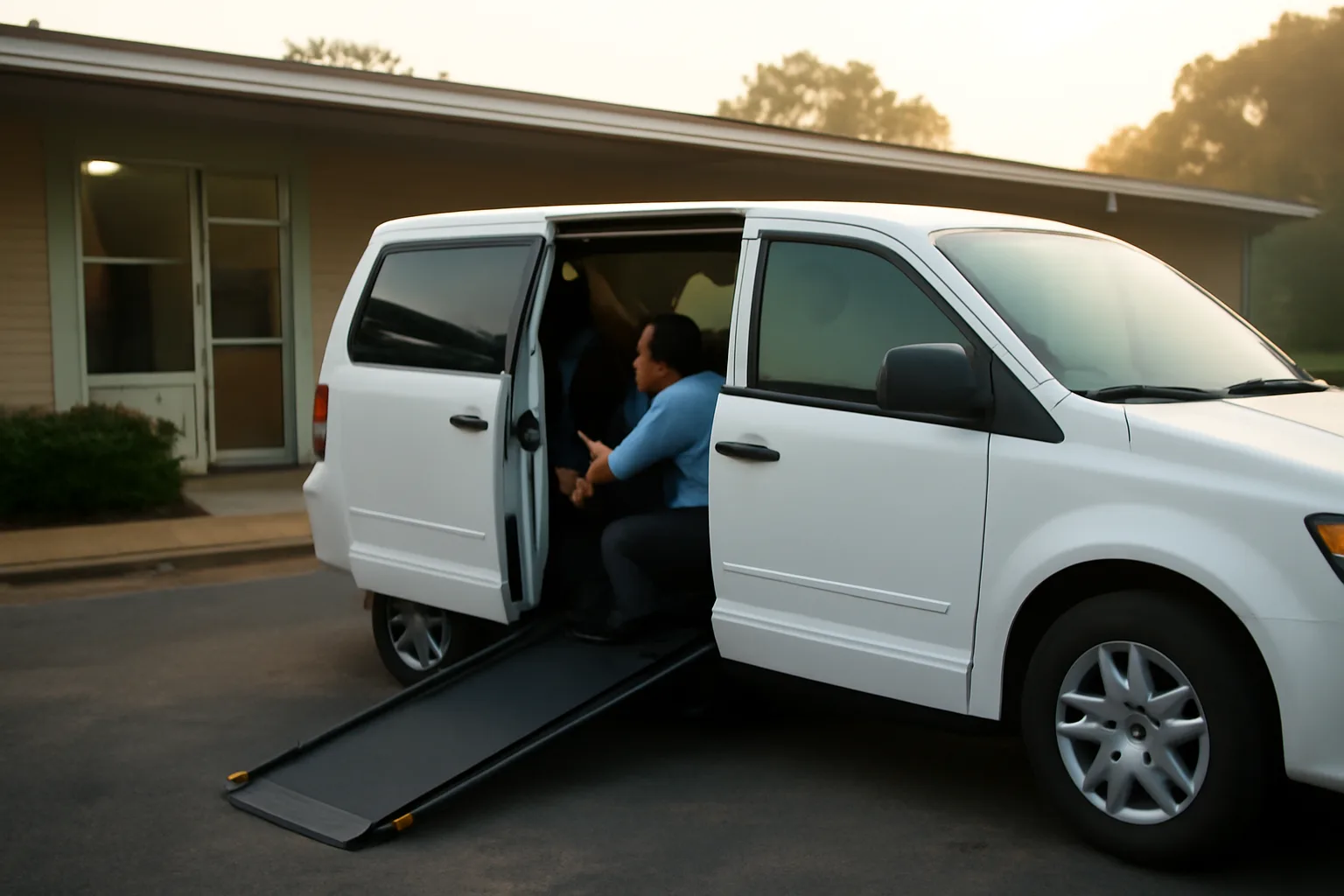
Non-emergency medical transportation, or NEMT, is scheduled transport for Medicaid and Medicare Advantage enrollees who can get to a medical appointment but can't drive themselves and don't need an ambulance. Think dialysis three times a week, physical therapy, dental visits, or a ride home after outpatient surgery. It's the opposite of emergency transport: no lights, no sirens, no paramedics. Money flows from the state Medicaid agency (or a Medicaid managed care plan) to a broker like Modivcare, MTM, Access2Care, or SafeRide, who then dispatches trips to contracted transportation providers, which is you. You get paid per completed trip, usually with a base rate plus a per-mile or per-loaded-mile add-on, sometimes with extra pay for wheelchair-accessible vehicles (WAVs) or stretcher runs. Medicaid.gov describes NEMT as a benefit states must generally offer under federal regulation, since transportation barriers otherwise keep enrollees from getting covered care [1]. The profit question is really a math question about four things: your per-trip broker rate, your loaded-mile ratio (how much of your driving is actually paid vs. deadheading back empty), your fixed costs (loan payment, insurance, permits), and your variable costs (fuel, maintenance, driver wages if you're not the one driving). Nobody publishes a clean "average NEMT profit margin" report the way they do for restaurants or trucking. What follows is the closest honest breakdown using general small-fleet transportation cost data plus how NEMT operators typically structure their pricing.
What are typical gross and net profit margins for a NEMT business?
| Fuel | 10-18% | |
|---|---|---|
| Driver wages (if not owner-operator) | 25-35% | |
| Vehicle loan/lease + depreciation | 8-15% | |
| Insurance | 8-15% | |
| Maintenance and repairs | 5-10% | |
| Broker/dispatch software fees | 1-3% | |
| Admin, licensing, misc overhead | 3-6% | |
| Net margin (residual) | 8-15% (owner-operator often higher due to no driver wage line) | These are directional ranges pulled from general small commercial fleet cost structures, not a single NEMT-specific government study. If someone quotes you a precise national "NEMT industry average margin" figure with a decimal point, ask for the source. It probably doesn't exist in the form they're implying. |
Gross margin (revenue minus direct trip costs like fuel, tolls, and driver pay) for small NEMT operations tends to run somewhere in the 20-40% range, based on patterns common across small-fleet passenger transportation. Net margin (after insurance, vehicle depreciation or loan payments, licensing, software or dispatch fees, and overhead) usually lands lower, often cited informally in the 8-15% range by NEMT consultants and state provider associations, though this is not backed by a single audited federal dataset. Why the spread? A one-van owner-operator who drives every shift himself has no driver payroll, so his "net margin" partly reflects his own labor, more than capital return. A three-van operator paying W-2 drivers hourly wages sees margin compressed by payroll taxes, workers' comp, and scheduling inefficiency. The U.S. Bureau of Labor Statistics tracks median pay for light truck and delivery services drivers, a related non-CDL passenger and courier occupational category, at $19.03 per hour ($39,590 annual) as of May 2023, which gives a rough anchor point for driver wage lines even though it isn't NEMT-specific [2]. Fuel is the biggest variable swing. The U.S. Energy Information Administration tracks weekly retail gasoline and diesel prices, and a $0.50/gallon swing on a van doing 150 miles a day can shift monthly fuel spend by several hundred dollars, which shows up directly in gross margin [3]. Insurance is the biggest fixed swing: commercial auto policies for wheelchair-accessible vans with livery or paratransit use often cost noticeably more than personal auto or even standard commercial policies, because insurers price in passenger liability exposure. Here's a rough illustrative structure (not a projection of your revenue, just how the cost buckets typically stack against each other as percentages of trip revenue): | Cost category | Typical % of revenue |
How to start a medical transportation business
Starting a medical transportation business means stacking four approvals in roughly this order: business registration, vehicle and insurance compliance, state Medicaid NEMT enrollment, and broker credentialing. Skipping the order costs you money, because brokers won't credential a business that isn't already an enrolled Medicaid transportation provider in most states. First, form your business entity (LLC is standard for liability separation) and get an EIN from the IRS. Second, register as a business in your state and get any required for-hire or livery permits; some states route this through the Department of Motor Vehicles, others through a transportation commission. Third, get commercial insurance that specifically covers wheelchair-accessible or livery passenger transport, not personal auto and not generic commercial auto without passenger endorsement. Fourth, enroll as a Medicaid NEMT transportation provider through your state Medicaid agency's provider enrollment portal; every state has one, and CMS requires states to have a documented process for assuring NEMT access under Medicaid transportation regulations [1]. Only after state enrollment (or sometimes in parallel, depending on the state) do you apply for broker network credentialing with Modivcare, MTM, Access2Care, SafeRide, or whichever broker holds the contract in your county. Confirm with your broker and state Medicaid agency which order they require, because it varies by state and even by region within a state. For a full walkthrough of state-by-state enrollment steps, see medical transportation and nemt.
How do you start a NEMT business with one van?
Starting a NEMT business with one van is entirely doable and is how most owner-operators begin; the real constraints are cash for the vehicle and insurance, and patience for the credentialing timeline, not fleet size. A single wheelchair-accessible van, properly equipped and insured, can be Medicaid-enrolled and broker-credentialed the same as a ten-van fleet. The vehicle itself is usually the biggest upfront cost. A new wheelchair-accessible van (side-entry or rear-entry conversion) commonly runs well into the $50,000-$80,000+ range depending on conversion type and lift/ramp system, while used conversion vans can run considerably less, though maintenance risk rises with age and mileage. Whether you buy new, buy used, or lease affects your monthly fixed cost line directly, which is the single biggest lever on your net margin as a one-van operator. With one van, you are almost certainly the driver, at least at first. That means no payroll cost, but it also means your own labor is unpaid in the "net margin" calculation unless you draw a specific salary. Many one-van operators find their real hourly return, after all costs, sits well below what the sticker-price margin percentage implies, because trip volume per day is capped by how many hours one person can drive and how much of that time is unpaid deadhead between trips. Check non emergency medical transportation for vehicle and equipment specifics relevant to single-van startups.
What is non-emergency medical transportation, exactly?
Non-emergency medical transportation (NEMT) is Medicaid-funded or Medicare Advantage-funded transport to and from covered medical services for people who don't need emergency care but can't get there on their own. It covers ambulatory (walking) passengers, wheelchair users, and in some programs, stretcher transport, but it excludes ambulance-level emergency response. Federal Medicaid regulation at 42 CFR 431.53 requires state Medicaid plans to "specify that the Medicaid agency will ensure necessary transportation for recipients to and from providers" and to describe in their state plan the methods they will use to meet that requirement [4]. States implement this differently: some run NEMT in-house, most contract it out to regional or statewide brokers. NEMT vehicle types typically include sedans, minivans, wheelchair-accessible vans (WAVs), and in some contracts, stretcher vans or ambulettes. Your Medicaid enrollment and broker credentialing usually specify exactly which vehicle class you're approved to run, and running a wheelchair trip in an uncertified sedan is a credentialing violation, more than a bad idea. See what is nemt and nemt transportation for a fuller breakdown of vehicle classes and trip types.
Does Medicaid cover ambulance rides?
Yes, Medicaid covers ambulance transportation when it's medically necessary, but that's a separate benefit category from NEMT and pays through a different billing pathway (ambulance providers bill Medicaid directly using ambulance-specific procedure codes, not through the NEMT broker network). Ambulance transport is for emergency or medically necessary situations requiring a licensed ambulance crew and equipment; NEMT is for stable patients who just need a ride. Medicaid.gov confirms transportation is a required benefit for state Medicaid programs to ensure enrollees can access covered services, and this includes both emergency ambulance services and non-emergency transport depending on medical need [1]. If you're building a wheelchair-van business, you are not in the ambulance business unless you separately obtain EMS licensure, staff licensed EMTs or paramedics, and equip an actual ambulance. Don't confuse NEMT wheelchair-van credentialing with ambulance service licensure; they are regulated by entirely different state agencies (Medicaid transportation unit vs. state EMS office) in almost every state.
Does Medicare cover medical transportation?
Medicare covers ambulance transportation when medically necessary under Medicare Part B, but original Medicare generally does not cover routine non-emergency medical transportation the way state Medicaid programs do. This is a common point of confusion for new NEMT operators who assume Medicare works like Medicaid. Some Medicare Advantage (Part C) plans offer NEMT as a supplemental benefit, meaning the coverage exists but varies plan by plan and is not a guaranteed federal entitlement the way Medicaid's transportation assurance is. The Medicare Part B benefit for ambulance services is described in the Medicare Benefit Policy Manual, Chapter 10, which covers the medical necessity and coverage conditions for ambulance transport specifically, not routine non-emergency rides [5]. If you want to serve Medicare Advantage members, you'd contract separately with those specific plans or their transportation vendor, which is a different credentialing process than state Medicaid NEMT enrollment. Confirm with each Medicare Advantage plan's transportation vendor directly, since there's no single national Medicare NEMT broker network equivalent to the state Medicaid systems.
How to start a NEMT business: the full enrollment sequence
The realistic sequence for how to start a NEMT business runs through six stages, and skipping ahead usually just means redoing paperwork later. Here's the order most states and brokers expect, though you should confirm with your broker and state Medicaid agency for exact sequencing in your area, since it does vary. 1. Business formation: LLC or corporation, EIN, business bank account. 2. Vehicle acquisition and equipment compliance: wheelchair lift/ramp systems typically need to meet Federal Motor Vehicle Safety Standards (FMVSS) for the conversion, and your state may require an inspection or certification specific to accessible vehicles. 3. Commercial insurance: livery or paratransit-rated commercial auto policy naming required coverage limits, which brokers will specify in their credentialing packet. 4. State Medicaid NEMT provider enrollment: application through your state Medicaid agency's provider portal, background checks (often including a state and FBI fingerprint check for drivers), and vehicle inspection. 5. Broker credentialing: separate application to Modivcare, MTM, Access2Care, SafeRide, or whichever broker manages your region, including their own insurance minimums, vehicle age limits, and driver qualification standards. 6. Driver qualification: defensive driving certification, passenger assistance training, CPR/First Aid in many states, and a clean MVR (motor vehicle record) check. Each broker sets its own minimum insurance limits, vehicle age cutoffs, and inspection cadence, and these differ from state Medicaid requirements, so you're often satisfying two separate rulebooks at once. This is the exact gap where a lot of new operators lose weeks: they get state-enrolled, then discover the broker wants a different insurance endorsement or a newer vehicle than they assumed. A structured checklist covering both the state enrollment packet and the broker credentialing packet side by side is the fastest way to avoid resubmitting paperwork twice; that's the specific gap RideCredential's $199 State + Broker NEMT Launch Kit is built to close, but you can also build your own checklist by pulling directly from your state Medicaid transportation unit's provider manual and each broker's published credentialing requirements. For state-specific requirements, start with nemt and non emergency medical transportation services.
What actually drives NEMT profit margins up or down?
Five levers move NEMT margin more than anything else: broker rate per trip, deadhead ratio, vehicle financing terms, insurance class, and trip density (how many paid trips you complete per driving hour). Broker rate per trip varies by state, by broker, and by vehicle type, and brokers generally don't publish rate cards publicly, so you'll need to confirm specific per-trip and per-mile rates directly during contracting. Wheelchair and stretcher trips typically pay more per trip than ambulatory sedan trips, which is part of why wheelchair-van operators often see better per-trip economics than sedan-only operators, assuming trip volume holds up. Deadhead ratio, the miles you drive without a paying passenger, is often the single biggest hidden margin killer. A driver who does a 20-mile loaded trip but then drives 15 empty miles back to the next pickup is burning fuel and time on half his mileage. Route density (multiple pickups in the same geographic cluster) directly improves this ratio, which is one reason NEMT operators in denser urban counties often report better margins than rural operators covering wide, sparse territories, even at similar per-trip rates. Vehicle financing terms matter more than people expect. A $70,000 wheelchair van financed at a high interest rate over five years carries a materially different monthly fixed cost than the same van bought used with a smaller loan, and that fixed cost hits your margin every month regardless of trip volume. Insurance class and claims history compound over time: a clean driving record fleet renews at better rates than one with accident claims, so driver training and defensive driving compliance isn't just a safety requirement, it's a margin protection strategy over a 3-5 year horizon.
NEMT vs. other transportation businesses: how do margins compare?
NEMT margins generally sit in a similar range to other regulated passenger transportation businesses like non-emergency paratransit and small-fleet taxi/livery operations, though direct comparative data specific to NEMT alone is thin in public sources. The main structural difference is payer stability. NEMT revenue comes from Medicaid or Medicaid managed care brokers, which pay on a set schedule (though reimbursement timing varies by broker and can run 2-4 weeks or longer after trip completion, so cash flow management matters more than in cash-based rideshare work). Rideshare and traditional taxi work has no guaranteed payer, more price competition, and more revenue volatility, but also generally lower vehicle-specific capital requirements since it doesn't need wheelchair conversion equipment. The wheelchair-van segment specifically carries higher upfront capital cost (the conversion equipment alone) but often better per-trip reimbursement to offset it, since brokers pay a premium for accessible vehicle capacity that's harder to source than standard sedans.
Where does the RideCredential Launch Kit fit into starting a NEMT business?
If you're staring at two separate rulebooks (your state Medicaid provider manual and your broker's credentialing packet) and trying to figure out which forms overlap and which don't, that's the exact problem a structured launch checklist solves. RideCredential's $199 one-time State + Broker NEMT Launch Kit bundles the state Medicaid enrollment checklist and broker credentialing checklist together so you're not discovering insurance or vehicle-age mismatches after you've already submitted one application. It's not a guarantee of approval from any state agency or broker, and it doesn't replace legal advice, but it's built specifically to compress the paperwork phase before you're moving vans and generating trip revenue. You can start there at ridecredential.com/launch-kit-builder.
Frequently asked questions
What is a typical net profit margin for a small NEMT business?
There's no single audited national figure, but small NEMT operators commonly report net margins in the 8-15% range after fuel, insurance, vehicle costs, and overhead, based on general small-fleet transportation cost patterns. Owner-operators who drive their own van often see a higher residual number, but part of that reflects unpaid personal labor rather than pure capital return.
How much does it cost to start a NEMT business with one van?
Costs vary widely by vehicle choice: a new wheelchair-accessible conversion van often runs $50,000-$80,000+, while used conversion vans cost considerably less but carry more maintenance risk. Add commercial livery insurance, state Medicaid enrollment fees (often modest, confirm with your state), and broker credentialing costs, which differ by broker and state.
Does Medicaid cover ambulance rides?
Yes. Medicaid covers medically necessary ambulance transportation under a separate benefit category from NEMT, billed directly by licensed ambulance providers using distinct procedure codes. Medicaid.gov confirms transportation, including emergency ambulance service, is a required benefit states must ensure enrollees can access.
Does Medicare cover non-emergency medical transportation?
Original Medicare Part B covers medically necessary ambulance transport but generally does not cover routine non-emergency medical transportation. Some Medicare Advantage (Part C) plans offer NEMT as a supplemental benefit, but coverage varies plan by plan, so you'd need to confirm directly with each Medicare Advantage plan's transportation vendor.
What is NEMT and who pays for it?
NEMT (non-emergency medical transportation) is scheduled transport to medical appointments for Medicaid enrollees who don't need emergency care but can't drive themselves. State Medicaid agencies fund it, usually paying through contracted brokers like Modivcare, MTM, Access2Care, or SafeRide, who then dispatch and pay individual transportation providers per completed trip.
How do I start a medical transportation business from scratch?
Form your business entity and get an EIN, secure a properly insured and equipped vehicle, enroll as a Medicaid NEMT provider through your state agency, then apply for broker network credentialing. Confirm the required order with your specific state Medicaid transportation unit, since sequencing requirements differ by state.
Can I start a NEMT business with just one wheelchair van?
Yes, one van is a completely standard starting point for NEMT owner-operators. Your main constraints are the vehicle and insurance cost, plus your own driving capacity, since with a single van you'll typically be the driver, which caps daily trip volume to what one person can physically complete.
What's the difference between gross margin and net margin in NEMT?
Gross margin is revenue minus direct trip costs like fuel and driver pay; NEMT operators commonly see this in the 20-40% range. Net margin subtracts fixed costs too (insurance, vehicle loan or lease, licensing, overhead) and typically lands in the 8-15% range, though neither figure comes from a single standardized national NEMT dataset.
Why do NEMT brokers require both state Medicaid enrollment and separate credentialing?
States set Medicaid provider enrollment rules to control who can bill the program at all, while brokers add their own network standards (insurance minimums, vehicle age limits, driver training) to manage service quality and liability across their contracted fleet. You generally need to satisfy both, and the requirements aren't identical.
What drives profit margin differences between NEMT operators?
Broker rate per trip, deadhead mileage ratio, vehicle financing costs, insurance class, and trip density (paid trips per driving hour) are the five biggest factors. Dense urban routes with tight pickup clusters typically outperform sparse rural routes on margin, even at similar per-trip broker rates.
Is NEMT more profitable than rideshare driving?
Direct comparative data is limited, but NEMT offers more payer stability (Medicaid-funded, scheduled trips) versus rideshare's cash volatility, while requiring higher upfront capital for wheelchair-accessible conversion equipment. Neither has a clean public margin benchmark, so the honest answer depends heavily on your local broker rates and route density.
How long does it take to get NEMT Medicaid enrollment and broker credentialing approved?
Timelines vary significantly by state and broker, often ranging from a few weeks to a couple months depending on background check processing, vehicle inspection scheduling, and document completeness. Confirm current processing timelines directly with your state Medicaid transportation unit and your target broker, since both can change without notice.
Sources
- Medicaid.gov, Non-Emergency Medical Transportation: NEMT is a required Medicaid benefit states must ensure to support access to covered medical services
- U.S. Bureau of Labor Statistics, Occupational Employment and Wage Statistics, Light Truck Drivers and Delivery Services (May 2023): Median hourly and annual wage figures for a non-CDL passenger and delivery driving occupational category relevant to NEMT driver pay
- U.S. Energy Information Administration, Gasoline and Diesel Fuel Update: Weekly retail fuel price tracking relevant to NEMT fuel cost volatility
- Electronic Code of Federal Regulations, 42 CFR 431.53: Federal Medicaid regulation requiring states to ensure necessary transportation for beneficiaries to and from providers
- CMS, Medicare Benefit Policy Manual, Chapter 10, Ambulance Services: Medicare Part B coverage conditions for ambulance transportation, distinct from routine non-emergency medical transportation
- U.S. Small Business Administration, Choose a Business Structure: LLC formation as a standard liability-separation structure for a new small business like an owner-operator NEMT company