Last updated 2026-07-25
TL;DR
Starting a NEMT business means forming a legal entity, getting the right insurance and vehicle equipment, enrolling as a Medicaid transportation provider in your state, and then credentialing with the broker (Modivcare, MTM, Access2Care, or similar) that manages rides in your area. Most owner-operators can do this with one wheelchair van, but timelines run 60 to 120+ days, so confirm exact steps with your state Medicaid agency.
What is non-emergency medical transportation (NEMT)?
Non-emergency medical transportation, or NEMT, is transportation to and from medical appointments for people who don't need an ambulance but can't drive themselves or use regular transit. Think dialysis three times a week, chemo infusions, physical therapy, or a wheelchair user going to a primary care visit. It's a Medicaid benefit in every state, and federal rule requires it. The Code of Federal Regulations at 42 CFR 431.53 requires state Medicaid plans to "ensure necessary transportation for beneficiaries to and from providers" [1]. States get to decide how they deliver that benefit, which is why the experience varies so much depending on where you operate. Some states run NEMT in-house through county offices. Most now contract it out to a regional or statewide broker. NEMT is not an ambulance. It's not staffed with EMTs, and it doesn't transport people in medical crisis. The vehicles range from sedans and minivans for ambulatory riders up to wheelchair-accessible vans and stretcher vans for riders who need more support. If you're buying your first vehicle, a wheelchair van is the most common entry point because demand for accessible rides tends to outstrip supply of accessible vehicles in most broker networks. For a broader look at how the industry is structured, see medical transportation and nemt.
How do you start a medical transportation business?
Starting a medical transportation business comes down to five things happening roughly in order: legal setup, vehicle and insurance, driver qualifications, state Medicaid enrollment, and broker credentialing. Skip a step and you'll get stuck later, usually at the broker stage when they ask for a document you don't have. First, form your entity. Most owner-operators use an LLC for liability separation, registered with their Secretary of State. You'll also need an EIN from the IRS (free, done online at irs.gov) and, in most states, a business or transportation license depending on local rules. Second, line up your vehicle. A used wheelchair van typically runs $18,000 to $45,000 depending on age, mileage, and the lift/ramp system, though this varies a lot by market and condition. It needs to meet your state's accessibility and safety inspection standards, which usually means a working wheelchair lift or ramp, working tie-downs (four-point is standard), and passenger restraints that meet the vehicle manufacturer's modification standards. Third, get commercial auto insurance built for NEMT, not a personal or standard commercial policy. Brokers typically require minimum liability limits, often $1 million combined single limit, though this number is set by each broker and state contract, not a federal standard, so confirm the exact figure with your broker and state Medicaid agency before you bind a policy. Fourth, get your drivers qualified: background checks, driving record pulls, drug screening, and often CPR/First Aid certification plus defensive driving or passenger assistance training. Fifth, enroll as a Medicaid provider in your state and then credential with whichever broker manages NEMT trips in your region. That's the part most new operators underestimate on time. Start it early.
How to start a NEMT business with just one van?
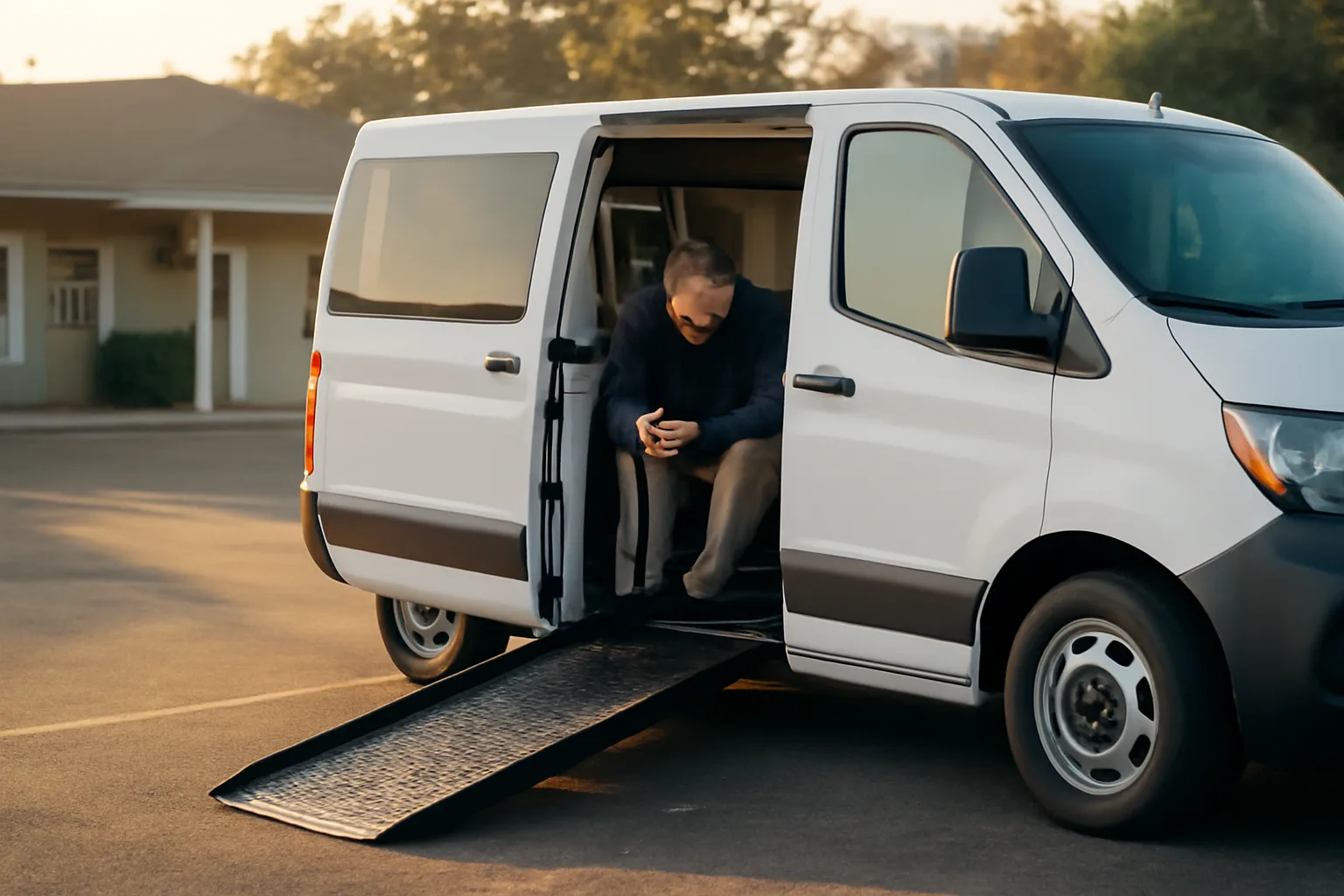
Yes, you can start with one van. In fact, one wheelchair van is how most owner-operators begin, and plenty of state Medicaid provider files list single-vehicle companies as active NEMT providers. Brokers don't generally require a fleet minimum to credential you, though some regional broker contracts do set service-area coverage expectations you should ask about directly. With one van, the practical constraints are different from a fleet operation. You can't accept every trip request, since you're one vehicle and one schedule. You need to be honest with the broker's dispatch system about your actual availability windows, because a pattern of declined or missed trips can affect your standing in their network. Confirm with your broker how they measure on-time performance and trip acceptance rates before you sign on, since penalties and even network removal are tied to those metrics in most broker contracts. One-van operators should also think hard about backup. What happens when your van is in the shop? Some owner-operators partner informally with another local operator for coverage; others just accept downtime. Either way, plan for it before your first trip, not after your transmission fails. The entity, insurance, and enrollment steps are identical whether you have one van or twenty. The paperwork doesn't get lighter with a smaller fleet. If anything, a single-vehicle operator needs every document airtight, because there's no other vehicle to fall back on if your file gets flagged for a lapse.
How do I enroll as a Medicaid NEMT provider in my state?
Every state Medicaid agency has a provider enrollment process, and NEMT providers typically enroll under a specific transportation provider type, separate from ambulance providers. The application usually goes through the state's Medicaid Management Information System (MMIS) provider portal. You'll generally need: your business's EIN and legal formation documents, vehicle registration and inspection records, proof of insurance, an NPI (National Provider Identifier) from the National Plan and Provider Enumeration System at nppes.cms.hhs.gov, driver credential files, and sometimes a state-specific transportation permit or certificate of public convenience. CMS requires state Medicaid agencies to screen providers according to a risk level (limited, moderate, or high) under 42 CFR 424.518, and transportation providers commonly fall into the "moderate" risk category, which typically means a site visit in addition to the standard licensure and database checks [2]. Expect someone from the state or its contracted enrollment vendor to actually come look at your vehicle and your business location. Processing time varies enormously by state and by how complete your application is. Some state Medicaid transportation units quote 30 to 45 days for a clean application; others run past 90. Because rules and forms change, confirm current requirements and timelines directly with your state Medicaid agency's transportation or provider enrollment unit before you submit anything. Once you're enrolled as a state Medicaid provider, that's your ticket to the next step, which is broker credentialing. States that carve out NEMT to a broker generally won't send you trips directly; the broker does that. Enrollment gets you into the state's system as a legitimate Medicaid provider, and credentialing gets you into the broker's active dispatch network.
How does broker credentialing work with Modivcare, MTM, and others?
Once your state Medicaid enrollment is active, you apply directly to the broker or brokers operating in your county. The big national names are Modivcare, MTM (Medical Transportation Management), Access2Care, and SafeRide Health, though many states also use regional brokers you won't have heard of outside your area. Broker credentialing is its own separate application, with its own document checklist, usually overlapping with but not identical to what the state asked for. Expect to submit vehicle photos (interior and exterior), current registration, insurance certificates naming the broker as certificate holder or additional insured, driver files including MVR (motor vehicle record) pulls and background check results, and often a signed broker services agreement or subcontractor agreement. Most brokers also require a vehicle inspection, sometimes conducted by broker staff, sometimes by a third-party inspection vendor the broker contracts with. This is separate from your state DOT or DMV safety inspection, so budget time for both. Each broker sets its own re-credentialing cadence, commonly annual, where you resubmit updated insurance, registration, and driver documents. Missing a re-credentialing deadline is one of the most common reasons active NEMT providers suddenly stop getting trips, so calendar it the day you get approved, not the week before it's due. Because broker requirements and the list of which broker covers which county change over time, confirm current specifics directly with the broker and your state Medicaid agency before you build your paperwork around anything you read online, including this article.
Does Medicaid cover ambulance rides?
Yes. Medicaid covers ambulance transportation when it's medically necessary, meaning the beneficiary's condition requires the medical monitoring, equipment, or trained personnel that an ambulance provides, and no other means of transport would be safe. This is a different benefit category from NEMT. CMS's Medicaid benefits page confirms that "transportation to and from a medical facility" is a mandatory benefit under Medicaid, and separately, ambulance services fall under a different provider type with different medical necessity documentation requirements than NEMT [3]. Ambulance transport typically requires a physician certification of medical necessity, especially for non-emergency ambulance transport (like a scheduled dialysis run for a bed-bound patient), under rules states adapt from Medicare's physician certification statement framework. If you're planning to launch an NEMT business, understand upfront that you are not entering the ambulance business. Ambulance providers need EMT or paramedic-licensed staff, different vehicle certifications, and typically a separate state EMS agency license on top of Medicaid enrollment. NEMT wheelchair vans and stretcher vans do not carry emergency medical equipment or EMT-certified crews (stretcher van attendants usually need CPR/First Aid certification, not EMT licensure, though state rules vary). Confusing the two in your business plan, your insurance application, or your Medicaid enrollment paperwork will slow you down fast, since ambulance and NEMT sit under different provider types and different regulatory oversight in nearly every state.
Does Medicare cover medical transportation?
Medicare's coverage of medical transportation is much narrower than Medicaid's, and this trips up a lot of new operators who assume the two programs work the same way. Medicare Part B covers ambulance services when other transportation would endanger the beneficiary's health, per CMS's Medicare Benefit Policy Manual [4]. Medicare generally does not cover routine non-emergency wheelchair van or livery-style transportation to medical appointments the way state Medicaid programs do. There are narrow exceptions. Some Medicare Advantage (Part C) plans offer supplemental NEMT benefits as an added perk beyond what original Medicare covers, and these vary plan by plan, sometimes contracting with the same brokers, like Modivcare, that manage state Medicaid NEMT. If you want Medicare Advantage transportation contracts, you'd apply to the specific MA plan or its transportation vendor, not to Medicare directly, and eligibility criteria differ from Medicaid's. This matters for your business plan because it shapes your revenue mix. Most NEMT owner-operators build their business around state Medicaid trips and broker contracts, not Medicare, because Medicare simply doesn't pay for the bulk of what NEMT vehicles do. If a Medicare Advantage plan in your area offers a transportation benefit, treat that as a separate credentialing conversation with the plan or its vendor, not an assumption baked into your Medicaid paperwork.
What vehicle and equipment requirements should I expect?
Every state sets its own NEMT vehicle standards, but a few things show up almost everywhere: a functioning wheelchair lift or ramp rated for the weights you'll carry, four-point wheelchair securement systems, working seatbelts for every seating position, a first aid kit, and a current annual (sometimes semi-annual) vehicle safety inspection. Many states also require your NEMT vehicle to display a state-issued permit decal or number, separate from your regular license plate, so a state inspector or broker auditor can confirm at a glance that the vehicle is an approved NEMT vehicle. Ask your state Medicaid transportation unit directly what decal, signage, or vehicle marking rules apply, since some states ban company branding on the exterior for rider privacy reasons while others require it. Age and mileage caps on vehicles vary by broker and state; some brokers won't credential a wheelchair van older than 7 to 10 model years or past a certain mileage threshold, though these thresholds are set contractually, not by any federal rule, so confirm current caps with the specific broker you're applying to. For a deeper comparison of vehicle types and what each is built for, see non emergency medical transportation and non emergency medical transportation services.
What does the realistic timeline look like from zero to your first trip?
| Stage | Typical range | What can slow it down | |
|---|---|---|---|
| Entity formation, EIN, licensing | 1 to 3 weeks | State backlog, missing local business license | |
| Vehicle purchase and modification/inspection | 2 to 8 weeks | Finding a properly equipped used wheelchair van, inspection scheduling | |
| Insurance binding | 1 to 2 weeks | Carriers unfamiliar with NEMT risk, needing broker-specific limits first | |
| Driver credentialing (background check, MVR, drug screen) | 1 to 4 weeks | Background check turnaround, training class availability | |
| State Medicaid provider enrollment | 30 to 90+ days | Incomplete applications, site visit scheduling, moderate-risk screening under 42 CFR 424.518 [2] | |
| Broker credentialing | 2 to 8 weeks after Medicaid enrollment | Separate document set, broker's own inspection, contract signature routing | Add it up honestly and most new owner-operators are looking at 60 to 120+ days from deciding to start to actually running a trip, sometimes longer in states with heavier screening or backlogged enrollment queues. Nobody publishes a national average for this because every state's MMIS enrollment system and every broker's onboarding queue runs differently. If someone promises you a two-week turnaround to "full broker approval," ask them exactly which state and which broker they mean, because that's not typical. The biggest time-saver is parallel processing: start your state Medicaid application and your insurance quote requests at the same time you're vehicle shopping, instead of waiting for one to finish before starting the next. |
What documents should I gather before I apply anywhere?
Build one folder, digital and physical, before you touch a single application. Trying to assemble documents application by application, broker by broker, is how people miss deadlines and resubmit three times. Core documents almost every state and broker will ask for: Articles of Organization or Incorporation, EIN confirmation letter from the IRS, NPI confirmation from NPPES, vehicle title and current registration, proof of commercial auto insurance meeting minimum limits, a copy of your state NEMT vehicle inspection or permit, each driver's license and MVR, background check results (often a state-specific criminal background check, sometimes run through the state Medicaid fraud unit's screening process), drug and alcohol testing program documentation if your state requires one, and a signed W-9. Some states and brokers also want a written policies and procedures manual covering things like rider no-show handling, wheelchair securement protocol, and incident reporting. If you don't have one yet, write a plain, honest one before you're asked; a thin but real policy document beats scrambling to produce one under a deadline. Building this packet from scratch, state by state and broker by broker, is genuinely the most time-consuming part of getting a single wheelchair van into active service. That's the exact gap the RideCredential $199 Launch Kit is built to close: a state-and-broker-specific document checklist and application walkthrough so you're not guessing what a given state Medicaid unit or a given broker actually wants.
What are the most common reasons applications get delayed or rejected?
Insurance certificates naming the wrong entity or missing the broker as certificate holder is probably the single most common snag. If your LLC name on the insurance certificate doesn't exactly match your Medicaid enrollment and broker application, expect a bounce-back. Incomplete driver files are next: an expired background check, a missing drug screen result, or an MVR that's more than the broker's allowed lookback window (commonly 3 years, though this varies) will stall credentialing even if your vehicle and entity paperwork is perfect. Vehicle age or mileage past a broker's cap is a frequent surprise for owner-operators who bought a good deal on an older van without checking broker requirements first. Ask before you buy, not after. And site visit no-shows or unpreparedness during the state's moderate-risk screening visit under 42 CFR 424.518 [2] can push your state enrollment back by weeks, since many states only schedule these visits periodically in a given region. The fix for basically all of these is sequencing: confirm broker vehicle and insurance requirements before you buy or bind anything, not after. A five-minute phone call to the broker's provider relations line before you sign a vehicle purchase agreement can save you a month later.
Do I need to work with just one broker, or can I credential with several?
You can generally credential with more than one broker if your state has more than one operating in your service area, and many owner-operators do exactly this to diversify trip volume. Some states carve up NEMT by region, so you might not have a choice; only one broker covers your county. Others allow multiple brokers to compete for the same region. Each broker relationship is a separate credentialing file, a separate contract, and a separate re-credentialing clock. That's more paperwork, not less, so weigh whether the extra broker relationship is worth the administrative overhead for where you are in your business. Also confirm whether your state allows or restricts you from also enrolling as a direct Medicaid transportation provider outside the broker system for services the broker doesn't cover (some states carve out certain trip types, like long-distance or out-of-state medical transport, separately from the regional broker's contract). Your state Medicaid transportation unit can tell you exactly how your state structures this. For context on how brokers differ in requirements and coverage footprint, see nemt transportation.
What should I know about emergency versus non-emergency transport as I plan my business?
If your long-term plan includes any ambulance or emergency medical transport, understand that's a fundamentally different license, workforce, and regulatory track than NEMT. Emergency medical transport requires state EMS agency licensure, EMT or paramedic-certified staff, and vehicles built and certified to ambulance specifications, none of which overlaps meaningfully with NEMT wheelchair van credentialing. Many successful NEMT operators never touch emergency transport at all and build a full business purely on wheelchair van and ambulatory sedan trips through Medicaid broker contracts. That's a legitimate, focused way to run this business, and it's simpler to credential and insure than trying to run both emergency and non-emergency lines under one operation. If you're weighing whether emergency transport is in your future, read up separately before you commit capital toward ambulance-spec vehicles; the licensing path (state EMS office, not the Medicaid transportation unit) and the credentialing path (911 contracts and hospital systems, not NEMT brokers) run on completely different tracks. See emergency medical transport for how that world differs from what's covered here.
Frequently asked questions
How to start a medical transportation business?
Form an LLC, buy or lease a properly equipped wheelchair van, get commercial NEMT insurance, get drivers background-checked and trained, enroll as a Medicaid transportation provider through your state's MMIS portal, then credential with the broker (Modivcare, MTM, etc.) covering your county. Budget 60 to 120+ days total and confirm exact steps with your state Medicaid agency.
What is NEMT?
NEMT stands for non-emergency medical transportation: rides to and from medical appointments for Medicaid beneficiaries who don't need an ambulance but can't drive themselves or use public transit. It's a mandatory Medicaid benefit under 42 CFR 431.53, delivered by wheelchair vans, ambulatory sedans, and stretcher vans, often through a state-contracted broker.
Does Medicaid cover ambulance rides?
Yes, Medicaid covers ambulance transportation when it's medically necessary, meaning the person's condition requires the equipment or trained personnel an ambulance provides. This is a separate benefit and provider category from NEMT, with its own physician certification and licensing requirements; confirm specifics with your state Medicaid agency.
Does Medicare cover medical transportation?
Original Medicare Part B covers ambulance services when other transport would endanger the patient's health, but it generally doesn't cover routine non-emergency wheelchair van rides to appointments. Some Medicare Advantage plans offer supplemental NEMT benefits as an add-on, but eligibility and coverage vary by plan, not by Medicare itself.
How do I start a NEMT business with just one van?
Yes, one wheelchair van is enough to start. You still need the full entity, insurance, driver, state Medicaid enrollment, and broker credentialing steps; there's usually no fleet-size minimum. Just plan for what happens when your one van needs repairs, since you'll have no backup vehicle for trips during that downtime.
What is non-emergency medical transportation?
Non-emergency medical transportation is transport for Medicaid (and some Medicare Advantage) beneficiaries to medical appointments, dialysis, therapy, and similar visits, using wheelchair vans, ambulatory sedans, or stretcher vans instead of an ambulance. It's a required Medicaid benefit under federal regulation, typically arranged through a state-contracted transportation broker.
How much does a wheelchair van for NEMT cost?
Used, properly equipped wheelchair vans commonly run $18,000 to $45,000 depending on age, mileage, and lift/ramp condition, though prices vary widely by market. Confirm your state and broker's vehicle age and mileage caps before buying, since some brokers won't credential vans past a certain model year.
What insurance do I need to become an NEMT provider?
You need commercial auto insurance built for passenger-for-hire NEMT use, not a personal or standard commercial policy. Brokers commonly require minimum liability limits around $1 million combined single limit and often require the broker to be named as additional insured or certificate holder; confirm exact limits with your broker and state.
How long does Medicaid provider enrollment take for NEMT?
It varies a lot by state, commonly 30 to 90 days for a complete application, sometimes longer if your provider type falls into moderate-risk screening under 42 CFR 424.518, which can require a site visit. Incomplete applications and site visit scheduling backlogs are the most common causes of delay.
Do I need an NPI number to become an NEMT provider?
Most states require an NPI (National Provider Identifier) as part of Medicaid provider enrollment, obtained free through NPPES at nppes.cms.hhs.gov. Some states also require it for broker credentialing. Confirm whether your specific state Medicaid transportation unit requires an NPI for your provider type before applying.
Can I credential with more than one NEMT broker?
Often yes, if your state has more than one broker operating in your area, though some states assign a single regional broker so you won't have a choice. Each broker is a separate application, contract, and re-credentialing cycle, so weigh the added paperwork against the benefit before pursuing multiple broker relationships.
What's the difference between NEMT and ambulance transportation?
NEMT moves people who don't need medical monitoring during the ride, using wheelchair vans, sedans, or stretcher vans without EMT-certified crews. Ambulance transportation requires EMT or paramedic staff, emergency medical equipment, a separate state EMS license, and applies when the patient's condition requires monitoring during transport.
Sources
- eCFR, 42 CFR 431.53: State Medicaid plans must ensure necessary transportation for beneficiaries to and from providers
- eCFR, 42 CFR 424.518: CMS requires states to screen Medicaid providers by risk level (limited, moderate, high), with moderate risk commonly including a site visit
- Medicaid.gov, Medicaid Benefits: Transportation: Transportation to and from medical care is a mandatory Medicaid benefit
- CMS, Medicare Benefit Policy Manual, Chapter 10 (Ambulance Services): Medicare Part B covers ambulance services when other transportation would endanger the beneficiary's health
- IRS, Apply for an Employer Identification Number (EIN) Online: Businesses can obtain an EIN free of charge directly from the IRS