Last updated 2026-07-25
TL;DR
The best coverage for a medical transportation business is commercial auto liability (often $1M combined single limit for wheelchair vans), general liability, workers' comp if you have employees, and non-owned/hired auto if you dispatch contractors. Brokers like Modivcare and MTM set their own minimums on top of state Medicaid rules, so confirm both before you quote a policy.
What is NEMT and why does it need special insurance?
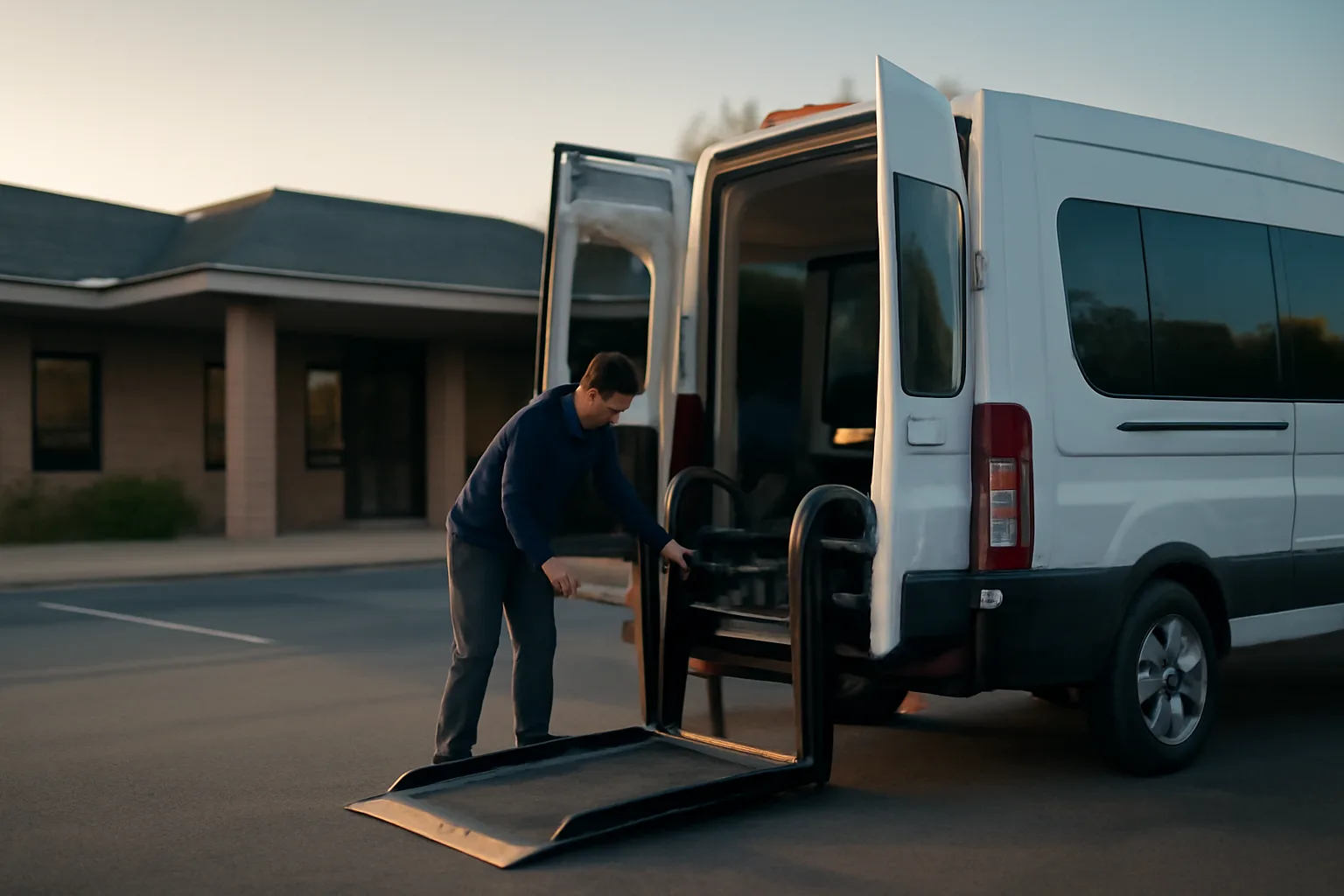
NEMT stands for non-emergency medical transportation. It is transportation to and from Medicaid-covered appointments, dialysis, therapy, and pharmacy pickups for people who don't need an ambulance but can't drive themselves or use a regular ride service. Wheelchair vans, ambulatory sedans, and stretcher vans all fall under this umbrella. Regular commercial auto or rideshare insurance usually will not cut it. NEMT vehicles carry passengers who may need a wheelchair lift, oxygen, or help transferring from a chair to a seat, and that changes the liability picture. A standard livery policy written for a limo or taxi company often excludes wheelchair lift operation or medical equipment onboard entirely, which means a claim gets denied right when you need it most. The Centers for Medicare & Medicaid Services describes NEMT as a required benefit for state Medicaid programs: "States must ensure necessary transportation for beneficiaries to and from providers" under the Medicaid transportation assurance rule [1]. That federal mandate is why almost every state has a formal broker network and a credentialing process, and why insurance requirements are usually spelled out in provider manuals rather than left to guesswork. For a plain-language rundown of what NEMT covers and who qualifies, see our overview of non emergency medical transportation.
What insurance coverage does a medical transportation business actually need?
| Commercial auto liability | $500,000 to $1,000,000 CSL | State Medicaid agency, brokers | |
|---|---|---|---|
| General liability | $1,000,000/$2,000,000 | Brokers, facility contracts | |
| Workers' comp | State-mandated limits | State labor law | |
| Non-owned/hired auto | Matches auto liability limit | Brokers, umbrella carriers | |
| Umbrella/excess | $1,000,000+ on top of primary | Larger contracts, hospital systems | These numbers are common ranges, not universal law. A state Medicaid transportation unit or a specific broker contract is the only source that fixes the exact number for your situation. |
Five coverage types come up again and again in broker contracts and state provider manuals. None of them are optional in practice, even if a given broker's minimum looks lower on paper. Commercial auto liability. This is the core policy. Most states and brokers expect at least $1,000,000 combined single limit (CSL) per occurrence for a wheelchair van carrying Medicaid passengers, though some ambulatory-only sedan contracts accept $500,000. Confirm the exact number with your broker and state Medicaid agency before you bind a policy, because it varies by vehicle type and by state. General liability. Covers slip-and-fall type claims at pickup, drop-off, or in your office if you have one. $1,000,000 per occurrence / $2,000,000 aggregate is a common floor in broker contracts. Workers' compensation. Required by state law in nearly every state once you have even one employee (a handful of states allow small exemptions for very small employers, so check your state labor department). If your drivers are true independent contractors, you may not need this, but misclassifying a driver to dodge workers' comp is a real legal risk, not a shortcut. Non-owned and hired auto liability. If you ever dispatch a contractor's own vehicle or rent a van to cover a shift, this fills the gap that your named-vehicle auto policy won't touch. Wheelchair lift and equipment liability. Sometimes bundled into auto, sometimes a separate rider. Ask specifically whether lift operation, tie-down failure, and stretcher transport are covered, more than excluded from a generic auto form. | Coverage | Typical minimum seen in broker/state contracts | Who usually requires it |
What is non-emergency medical transportation (NEMT), exactly?
NEMT is the Medicaid and Medicare Advantage benefit that gets people to medical appointments when they don't need an ambulance. It covers dialysis three times a week, cancer treatment, physical therapy, mental health appointments, and routine primary care for beneficiaries who lack another way to get there. The vehicle types under NEMT usually break into three tiers: ambulatory (a sedan or minivan for someone who can walk and sit normally), wheelchair-accessible (a van with a lift or ramp), and stretcher van (for someone who must travel lying down but doesn't need clinical care en route). Each tier has different vehicle inspection standards and often different insurance minimums. NEMT is distinct from ambulance transport, which involves medical monitoring and is billed as a separate Medicare and Medicaid benefit category entirely. Federal Medicaid regulation at 42 CFR 440.170 defines "transportation" as a covered service that states may include in their state plan, separate from emergency ambulance services [2]. For state-specific detail on how each state runs its NEMT program, our NEMT and NEMT transportation guides break down the broker landscape state by state.
Does Medicaid cover ambulance rides?
Yes, Medicaid covers ambulance rides, but this is a different benefit than NEMT and usually billed under a different provider type entirely. Medicaid covers ambulance transport when it's medically necessary, meaning the person's condition requires monitoring, immobilization, or emergency-level care during transport. CMS guidance confirms states must cover "necessary transportation" including ambulance services when medical necessity is documented, though each state Medicaid program sets its own coverage rules, prior authorization requirements, and reimbursement rates for ambulance providers [1]. If you're building a wheelchair-van NEMT business, you generally do not need ambulance-level licensure, EMT-certified staff, or the same equipment as an ambulance provider, because NEMT explicitly serves people who do not need emergency-level care. Don't confuse the two when you're shopping insurance. An ambulance company usually carries medical malpractice coverage and much higher liability limits because of the clinical care being delivered onboard; a wheelchair-van NEMT business typically does not need medical malpractice coverage at all, since drivers aren't providing clinical care. Confirm this distinction with your state Medicaid agency, since a few states blur the line for certain stretcher-van contracts.
Does Medicare cover medical transportation?
Medicare covers ambulance transportation under Medicare Part B when it's medically necessary and other transportation would endanger the person's health, per CMS's ambulance services coverage rules [3]. Standard Medicare (Parts A and B) generally does not cover routine NEMT rides to a doctor's appointment. Medicare Advantage plans are a different story. Many Medicare Advantage (Part C) plans now offer NEMT as a supplemental benefit under CMS's expanded supplemental benefits authority for chronically ill enrollees, which the agency finalized in the Contract Year 2019 Medicare Advantage and Part D final rule [4]. If you're pursuing contracts beyond Medicaid, Medicare Advantage plan transportation networks (often run through the same brokers, like Modivcare or MTM) are worth asking about during credentialing, since the insurance and vehicle requirements are usually similar to Medicaid NEMT contracts but the enrollment paperwork is separate.
How do you start a medical transportation business?
Starting a medical transportation business runs through roughly six stages, and skipping ahead on any of them tends to cost you time later, not save it. 1. Pick your business structure and get an EIN. Most owner-operators form an LLC for liability separation, then get a federal Employer Identification Number from the IRS. 2. Get the right vehicle. A used wheelchair van with a working lift, tie-downs rated for the wheelchair weight, and a clean inspection history is the baseline. Confirm your state's vehicle age and mileage caps with the state Medicaid transportation unit before you buy, since some states won't credential a van over a certain age. 3. Buy insurance that matches broker and state minimums. This is the step people underprice. Call at least two commercial auto carriers that specifically write NEMT or livery risk, more than a general commercial auto agent, since many general agents don't know the wheelchair-lift exclusion issue exists. 4. Register as a Medicaid transportation provider in your state. This usually means an application through the state Medicaid agency or its NEMT broker, a background check, vehicle inspection, and driver qualification file. 5. Get credentialed with the broker(s) operating in your state. Most states contract NEMT out to a broker (Modivcare, MTM, Access2Care, SafeRide, or a state-specific one). Credentialing is a separate process from Medicaid enrollment and has its own insurance certificate, W-9, and vehicle inspection requirements. 6. Set up driver qualification files and ongoing compliance. Drug testing, motor vehicle record checks, and CPR/first aid certification are standard requirements almost everywhere, though specifics vary by state. For the enrollment mechanics in more depth, see medical transportation and non emergency medical transportation services.
How do you start a NEMT business with just one van?
Starting with one van is how most NEMT owner-operators actually begin, and it's a completely workable model as long as you treat insurance and credentialing as the priority, not an afterthought. The practical sequence: buy or convert one wheelchair-accessible van, get it inspected to your state's NEMT vehicle standard, insure it at broker-required limits (confirm the number, don't assume $500,000 is enough), and apply for Medicaid provider enrollment as a sole proprietor or single-member LLC. Many states let a one-van operator enroll directly rather than requiring a fleet minimum, though a few states or brokers do set a minimum vehicle count for certain contract types, so confirm this with your state Medicaid transportation unit before you commit to buying. The insurance cost is usually the biggest surprise for one-van operators. Commercial auto for a wheelchair van with $1,000,000 CSL frequently runs several thousand dollars a year, meaningfully more than a personal auto policy, because the carrier is underwriting passenger transport of a vulnerable population plus lift liability. Shop this before you sign a purchase agreement on the van, not after, since the insurance quote can change whether the whole plan pencils out. One administrative shortcut worth knowing about: some owner-operators use a packaged document kit to organize the state Medicaid application, broker credentialing packet, and required forms in one pass instead of hunting them down separately across a dozen agency PDFs. RideCredential's $199 one-time State + Broker NEMT Launch Kit is built for exactly that first-van scenario; you can start one at /launch-kit-builder. It doesn't replace insurance shopping or guarantee approval, it just organizes the paperwork trail.
What does broker credentialing actually check, and how does it affect insurance?
Broker credentialing is separate from state Medicaid enrollment, and it's where insurance certificates get scrutinized line by line. Modivcare, MTM, Access2Care, and SafeRide each run their own credentialing process for the states where they hold the broker contract, and each has its own certificate-of-insurance format, minimum limits, and additional-insured wording requirements. Common credentialing checks include: a current certificate of insurance naming the broker as additional insured (more than proof of coverage), vehicle inspection reports often renewed annually, driver background checks and MVR pulls, drug and alcohol testing program documentation, and sometimes a physical vehicle inspection by broker staff before your first trip is authorized. A mismatch between your policy limits and the broker's stated minimum is one of the most common reasons credentialing gets kicked back for revision. If your policy says $500,000 CSL and the broker's contract requires $1,000,000, you'll be asked to amend the policy before you're approved, which costs you calendar time waiting on your insurance carrier to reissue the certificate. Get the broker's exact insurance requirement in writing before you buy or renew a policy, not after. Broker requirements also change without much public notice. Confirm current minimums directly with each broker and cross-check against your state Medicaid transportation unit's provider manual, since the two documents don't always match and the higher number usually wins in practice.
How much does NEMT insurance typically cost, and what drives the price?
There's no single national number, and anyone quoting you a flat rate without knowing your state, vehicle count, and driving records is guessing. But a few real cost drivers show up consistently across state Medicaid provider manuals and broker contracts. Vehicle type is the biggest driver. A wheelchair-lift van costs more to insure than an ambulatory sedan because of lift liability and the higher-risk passenger population. Stretcher vans generally cost even more. Driving history matters more in this industry than in general commercial trucking, because a single at-fault accident with a wheelchair passenger onboard is a much larger claim than a routine fender-bender. Carriers price this in heavily. Claims history and years in operation affect renewal pricing significantly; a first-year operator with no claims history typically pays more than a five-year operator with a clean record, all else equal, because the carrier has no loss data to work from yet. Geography matters too. Urban routes with more traffic density and higher per-claim litigation costs in that state's court system tend to price higher than rural routes, though state no-fault or tort rules also shift this. The honest advice: get at least three quotes from carriers that specifically underwrite NEMT or paratransit risk (search for "NEMT insurance" or "paratransit insurance" specifically, not generic commercial auto), and ask each one directly whether wheelchair lift operation and passenger assist are covered under the base policy or require a rider.
What mistakes do new NEMT owner-operators make with insurance?
The single most common mistake is buying a standard livery or limo policy and assuming it covers wheelchair lift operation. It often doesn't, and you won't find out until a claim gets denied. Second most common: insuring at the state Medicaid minimum without checking the broker's separate, usually higher, minimum. States set a floor; brokers often set their own ceiling above it. Both apply to you if you want the broker contract. Third: misclassifying drivers as independent contractors to avoid workers' comp, then getting hit with a state labor department audit or a claim that falls entirely on the business owner because the coverage gap wasn't planned for. Fourth: letting the certificate of insurance lapse or forgetting to renew the broker's additional-insured endorsement on schedule. Credentialing files get suspended for expired insurance certificates more often than for almost any other single paperwork issue, and reinstatement can take longer than the original approval did. Fifth: assuming one insurance policy covers every broker relationship in every state you operate in. If you run vans in two states or contract with two brokers, confirm each one's specific minimums separately rather than assuming your existing certificate satisfies both.
How is NEMT different from other medical transport, and does that change your coverage needs?
NEMT sits below ambulance transport and above rideshare on the acuity scale, and that middle position is exactly why its insurance needs are distinct from both neighbors. An emergency medical transport provider (ambulance, typically) carries EMT or paramedic staff, medical equipment, and usually medical malpractice or professional liability coverage on top of auto and general liability, because clinical care happens onboard. A rideshare driver carries standard personal or rideshare-endorsed auto insurance with no lift liability or passenger-assist exposure at all. NEMT falls in between: no clinical care, but real physical assistance (wheelchair loading, seatbelt securement, sometimes a two-person lift-assist) and a passenger population more likely to have a fall or medical event during transport than the general public. That's the specific risk commercial auto, general liability, and lift-equipment coverage are underwriting for in an NEMT policy, and it's why a generic commercial auto agent who hasn't written NEMT risk before will often under-quote the exposure. If you're weighing NEMT against other transport business models before you commit to a vehicle purchase, our comparisons hub has side-by-side breakdowns worth reading first.
Frequently asked questions
How do you start a medical transportation business?
Form an LLC, get an EIN, buy or convert a wheelchair van that meets your state's inspection standard, secure commercial auto and general liability insurance at broker-required limits, enroll as a Medicaid transportation provider through your state agency, and get credentialed with the broker operating in your state (Modivcare, MTM, Access2Care, or SafeRide, depending on region).
Does Medicaid cover ambulance rides?
Yes. Medicaid covers medically necessary ambulance transport as a distinct benefit from NEMT, governed by 42 CFR 440.170. Coverage rules, prior authorization, and reimbursement rates vary by state, so confirm specifics with your state Medicaid agency rather than assuming national uniformity.
What is NEMT?
NEMT (non-emergency medical transportation) is transportation to medical appointments, dialysis, and therapy for Medicaid beneficiaries who don't need an ambulance but can't drive themselves. It includes ambulatory sedan, wheelchair-van, and stretcher-van service tiers, each with its own vehicle and insurance requirements.
Does Medicare cover medical transportation?
Original Medicare Part B covers ambulance transport when medically necessary, but generally does not cover routine NEMT rides. Many Medicare Advantage (Part C) plans now offer NEMT as a supplemental benefit, often through the same brokers used for Medicaid NEMT contracts.
What is non-emergency medical transportation?
Non-emergency medical transportation is a Medicaid (and sometimes Medicare Advantage) benefit covering rides to appointments for people who need help getting there but don't require ambulance-level medical care. It's delivered by wheelchair vans, ambulatory sedans, and stretcher vans through state-contracted brokers.
How do you start a NEMT business with one van?
Buy one properly inspected wheelchair-accessible van, insure it at your broker's required limits (often $1,000,000 CSL, confirm exact numbers), enroll as a Medicaid provider (often allowed as a sole proprietor or single-member LLC), and complete broker credentialing. Most states don't require a minimum fleet size, but confirm this with your state Medicaid agency.
What insurance limits do NEMT brokers typically require?
Common minimums seen in broker contracts are $1,000,000 combined single limit for commercial auto liability and $1,000,000/$2,000,000 for general liability, though exact figures vary by broker and state. Always get the broker's current written requirement rather than relying on a general industry number.
Do I need workers' compensation insurance for NEMT drivers?
If you have employees, yes, in nearly every state, with limited exceptions for very small employers that vary by state labor law. If your drivers are properly classified independent contractors, workers' comp may not be legally required, but misclassification carries its own legal and financial risk.
Is medical malpractice insurance required for NEMT businesses?
Generally no. NEMT drivers don't provide clinical care, so medical malpractice coverage isn't typically required the way it is for ambulance (emergency medical transport) providers. NEMT relies on commercial auto, general liability, and sometimes a lift-equipment rider instead.
Can I use my personal auto insurance for an NEMT business?
No. Personal auto policies exclude commercial passenger transport, and a claim involving a paying Medicaid passenger will likely be denied under a personal policy. You need a commercial auto policy specifically underwritten for NEMT or livery/paratransit risk.
How long does NEMT broker credentialing take?
Timelines vary widely by broker and state, and nobody publishes a reliable national average. Expect it to take longer than expected if your insurance certificate doesn't match the broker's stated limits on the first submission, since that's the most common reason files get sent back for correction.
What's the difference between state Medicaid enrollment and broker credentialing?
State Medicaid enrollment registers you as an approved Medicaid provider under your state's rules. Broker credentialing is a separate process required by the private company (Modivcare, MTM, Access2Care, SafeRide) that manages ride dispatch and payment in your area. You generally need both to actually get trip assignments.
Sources
- CMS, Medicaid.gov Transportation page: States must ensure necessary transportation for Medicaid beneficiaries to and from providers
- eCFR, 42 CFR 440.170: Federal definition of transportation as a coverable Medicaid state plan service
- CMS, Medicare Ambulance Services coverage: Medicare Part B covers ambulance transportation when medically necessary
- Federal Register, Medicare Program; Contract Year 2019 Policy and Technical Changes to the Medicare Advantage, Medicare Cost Plan, Medicare Fee-for-Service, and the Medicare Prescription Drug Benefit Programs (83 FR 16440): CMS expanded flexibility for Medicare Advantage plans to cover non-emergency transportation as a supplemental benefit
- 42 U.S.C. 1396d(a)(29), Social Security Act Section 1905(a): Statutory basis for transportation as a Medicaid medical assistance service
- eCFR, 42 CFR 431.53: Federal requirement that states assure necessary transportation to and from Medicaid providers