Last updated 2026-07-25
TL;DR
Florida non emergency medical transportation (NEMT) moves Medicaid members to covered medical appointments when they have no other way to get there. In Florida, most rides run through managed care plans and their transportation brokers (commonly Modivcare or MTM), not straight through the state. You'll need a Florida business entity, a Medicaid provider enrollment through the state's fiscal agent, DOT-compliant wheelchair vans, and broker credentialing before you carry a single paying passenger.
What is non emergency medical transportation (NEMT)?
Non emergency medical transportation is scheduled transport for people who have a medical need but aren't in an ambulance-level emergency. Think dialysis three times a week, chemo infusions, physical therapy, or a routine OB visit for someone who can't drive and has no ride. The vehicle is usually a wheelchair van, a sedan, or an ambulatory minivan, not a rig with lights and a siren. Federal Medicaid rules require states to make sure eligible people can get to and from covered services. The regulation is blunt about it: states must "ensure necessary transportation for beneficiaries to and from providers" and may do that directly, through contracts, or through broker arrangements [1]. That single rule is the reason Modivcare, MTM, Access2Care, and similar brokers exist in nearly every state, including Florida. NEMT is different from ambulance transport in the eyes of Medicaid and Medicare. Ambulance transport, especially emergency ambulance, is billed under totally different codes and often paid at a higher rate because it involves clinical staff and life-support equipment. NEMT is livery-plus-assistance: a driver, a ramp or lift, tie-downs, and someone who knows how to safely load a wheelchair. If you're comparing the two service lines for your business plan, the emergency medical transport side of the industry has a separate licensing track in Florida (ambulance permits through the county and state), which most wheelchair-van owner-operators don't need.
Does Medicaid cover ambulance rides, and how is that different from NEMT?
Yes, Medicaid covers ambulance transportation when it's medically necessary, but that's a separate benefit from NEMT and it's billed differently. Ambulance coverage under Medicaid generally requires that other transportation would endanger the person's health, per federal guidance describing medically necessary transportation [2]. NEMT, by contrast, covers people who need a ride but aren't in a medical emergency, just a mobility or access bind. In Florida, ambulance providers (ALS and BLS) enroll separately from NEMT providers and go through county/state EMS licensure, not broker credentialing. If your business plan is strictly wheelchair vans and ambulatory sedans, you don't need an ambulance permit. If you're also running a stretcher van or BLS transport, check with the Florida Department of Health's Bureau of EMS about separate licensure, since stretcher-level, non-emergency transport sometimes falls under EMS rules depending on the level of care involved. Confirm the current line between "wheelchair van" and "BLS ambulance" with your state Medicaid agency and county EMS office, because it varies and gets enforced unevenly. Does Medicare cover medical transportation the same way? No. Medicare Part B covers ambulance transportation when medically necessary, and it has limited coverage for scheduled non-emergency ambulance transport if a physician certifies the need in writing [3]. Medicare generally does not cover routine wheelchair-van or livery-style NEMT the way Medicaid does. That's a big reason NEMT fleets build their business almost entirely around Medicaid managed care contracts and brokers rather than Medicare billing.
How do Florida Medicaid NEMT and broker credentialing actually work?
Florida runs Medicaid through managed care plans under its Statewide Medicaid Managed Care (SMMC) program, and those plans typically contract out trip management to a broker. That means most Florida NEMT owner-operators deal with a broker's credentialing packet, not a state agency portal, for day-to-day trip assignment, even though the state ultimately sets the Medicaid rules. The brokers active in Florida SMMC regions have shifted over the last several years as plans re-bid contracts, and coverage areas differ by region. Confirm with your state Medicaid agency and each relevant health plan which broker currently holds transportation management in your county, because a broker's footprint can change mid-year when a plan switches vendors. Don't build a business plan around one broker's name; build it around the process, since the players change. What the credentialing packet usually asks for, across brokers like Modivcare and MTM, tends to include: a completed provider/vendor application, proof of Florida business registration, general and auto liability insurance certificates naming the broker as certificate holder, vehicle inspection records, driver background checks and drug screening results, driver training or certification records, and a signed transportation services agreement or contract. Exact requirements, insurance minimums, and fees vary by broker and change without much public notice, so confirm the current checklist directly with the broker before you spend money on any single item. Separately, to bill Florida Medicaid at all (even indirectly through a plan), most providers need to enroll with Florida Medicaid through the state's fiscal agent portal. Florida's Medicaid provider enrollment is handled through the Agency for Health Care Administration (AHCA) in partnership with the fiscal agent, and provider enrollment applications and requirements are published on the Florida Medicaid provider enrollment pages [4]. Read the current enrollment guidance directly on AHCA's site before assuming anything about fees or timelines, since Medicaid provider enrollment rules get updated periodically.
How to start a medical transportation business in Florida (step by step)
Here's the realistic order of operations, not the marketing-brochure version. 1. Pick your entity and register it. Most owner-operators form an LLC through Florida's Division of Corporations (Sunbiz). You'll need this before almost any other step, because insurance carriers, brokers, and Medicaid all want a registered legal entity, not a sole proprietor doing business under a personal name. 2. Get your EIN from the IRS and open a business bank account. Cheap, fast, and every broker application asks for it. 3. Buy or lease your vehicle before you assume anything about revenue. A used, ADA-compliant wheelchair van typically runs somewhere in the $28,000 to $55,000 range depending on age, mileage, and ramp vs. lift configuration; new conversions run considerably higher. Get the vehicle inspected against ADA and state accessibility standards before you commit, since a failed inspection later can stall your broker credentialing for weeks. 4. Secure commercial auto insurance with the liability limits your target broker requires. This is often the single biggest recurring cost in the business and the item most likely to trip up first-timers, because personal auto or standard commercial policies usually don't cover livery/NEMT use. 5. Get driver requirements squared away: background checks, drug screening, defensive driving or passenger-assistance training, and a valid license class appropriate to your vehicle. Florida doesn't require a CDL for most standard wheelchair vans under the usual weight thresholds, but brokers commonly require their own driver training modules regardless. 6. Enroll as a Florida Medicaid provider through AHCA's fiscal agent portal, following the current published Florida Medicaid provider enrollment application requirements [4]. 7. Apply for broker credentialing with each broker operating Medicaid NEMT trips in your county (confirm with your state Medicaid agency and the relevant health plans which broker holds that contract right now). 8. Get your trip-assignment technology set up. Most brokers dispatch through their own app or a required third-party platform; budget time to learn it, since a slow response rate on trip offers can affect how many trips you get assigned. How to start a NEMT business with one van follows the identical sequence; the volume is just smaller. One van is a completely normal, viable way to start. The credentialing steps, insurance requirements, and inspection standards are the same whether you own one van or ten; what changes is your ability to cover multiple simultaneous trip requests, which affects how a broker weighs your application relative to a larger fleet in a competitive region.
What does a wheelchair van need to meet Florida and ADA standards?
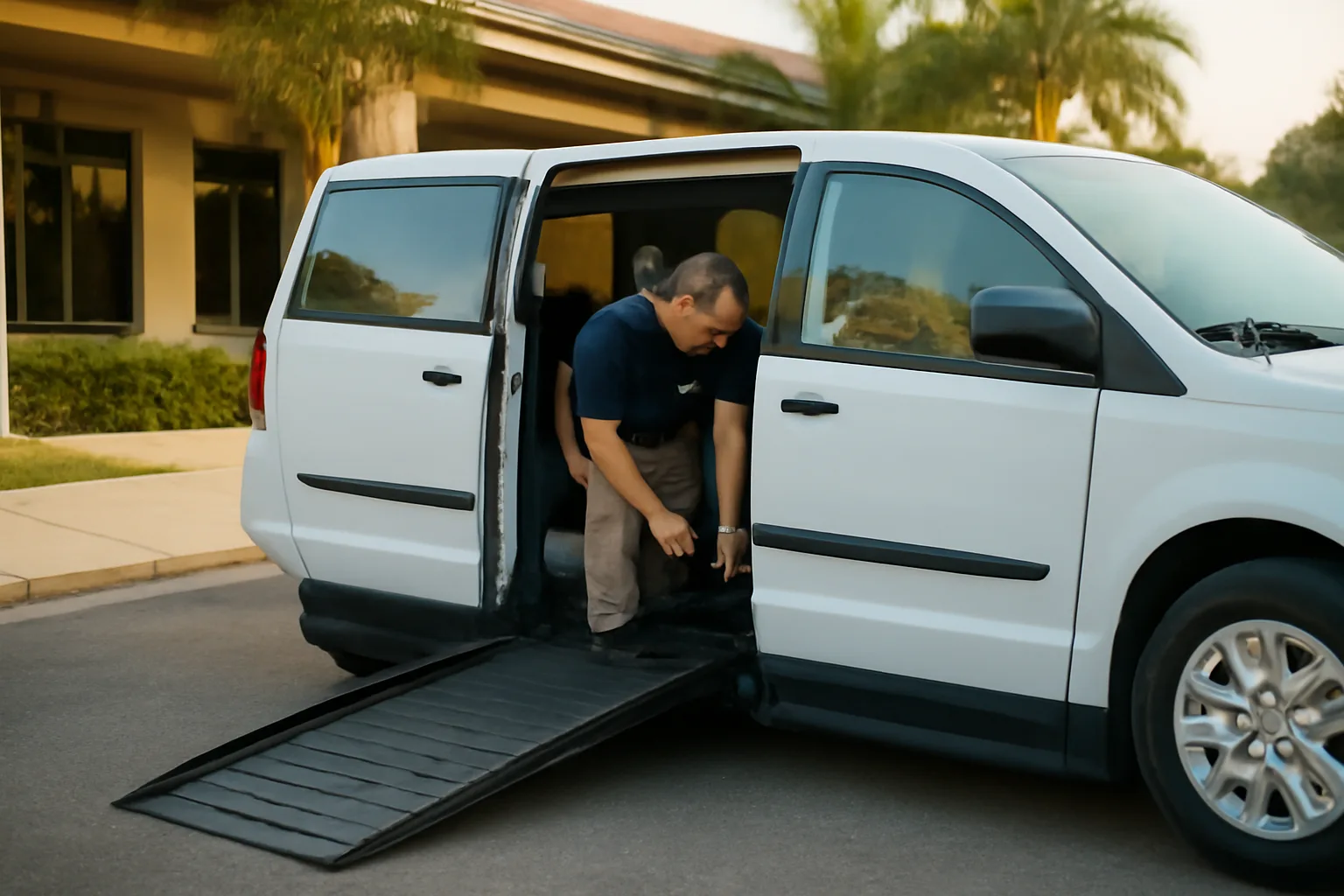
Your vehicle needs a working wheelchair lift or ramp, secure four-point tie-down systems, working lap and shoulder restraints for the wheelchair occupant, and clearances that let a chair maneuver safely inside the cabin. Brokers typically require annual (sometimes semiannual) vehicle inspections, proof of state vehicle registration, and current emissions or safety inspection where applicable. ADA accessibility standards for vehicles are set out in federal transportation regulations, and passenger vehicle accessibility requirements (used as a reference point by many state Medicaid transportation programs) are detailed in the Department of Transportation's ADA regulations for transportation vehicles [5]. Florida doesn't publish a separate, NEMT-specific vehicle equipment statute distinct from general vehicle and insurance code, so most of the hard technical requirements you'll actually be held to come from your broker contract and general Florida vehicle/insurance law rather than a single NEMT vehicle statute. Confirm current vehicle equipment specifics directly with each broker, since they audit to their own checklist. For general Florida commercial vehicle registration and insurance requirements, the Florida Department of Highway Safety and Motor Vehicles publishes registration and insurance rules that apply to for-hire vehicles [2]. If you're weighing a wheelchair van conversion against building a mixed fleet with an ambulatory sedan or minivan, our vehicles and equipment coverage on ridecredential.com walks through the trade-offs in more depth.
How much does it cost to start a Florida NEMT business?
There's no single official number for this because Florida doesn't license NEMT the way it licenses, say, a home health agency, so there's no state fee schedule to point to. What's real and unavoidable: Sunbiz LLC filing fees, commercial auto and general liability insurance premiums (often the largest recurring line item), the vehicle purchase or lease itself, driver background checks and drug screens, and any broker-specific credentialing or onboarding fees. Don't trust any number you see online for exact broker fees or exact insurance premiums; both vary by carrier, by county, by your driving history, and by which broker you're credentialing with, and they change year to year. Get actual quotes before you build a budget around a guess. What you should budget time for, more than money: vehicle inspection scheduling, insurance underwriting turnaround (can take one to three weeks), background check processing, and broker application review, which can run anywhere from a couple of weeks to a couple of months depending on the broker's current backlog. None of this is instant, so plan your first-trip date with real slack in it.
How do you get credentialed with Modivcare, MTM, or other Florida brokers?
Each broker runs its own vendor/provider portal, and you'll typically start by submitting a transportation provider application through that broker's website, along with your insurance certificates, vehicle list, driver roster, and business registration documents. Some brokers require an in-person or virtual orientation before your application is reviewed. Because broker contracts in Florida's SMMC regions change over time (a plan can switch which broker manages its transportation network when contracts are re-bid), the specific broker you'll apply to depends on the county and the Medicaid managed care plan whose members you want to transport. Confirm with your state Medicaid agency's managed care division and with the relevant health plans directly which broker currently holds the transportation contract for your service area before submitting anything. A few things that consistently slow down credentialing, regardless of broker: insurance certificates that don't name the broker as certificate holder correctly, vehicle inspection reports that are expired or missing a signature, driver background checks that are older than the broker's acceptable window (often 30 to 90 days, varies by broker), and incomplete W-9 or banking information for payment setup. Get every document broker-ready before you submit, since most portals don't let you partially save and resume cleanly. For a broader look at how credentialing works across brokers nationally, our broker guides hub covers Modivcare, MTM, Access2Care, and SafeRide processes side by side, which is useful if you're weighing which broker relationships to prioritize first.
What's the realistic timeline from zero to your first Medicaid trip?
| LLC formation (Sunbiz) | 1 to 5 business days | |
|---|---|---|
| EIN and business banking | Same day to 1 week | |
| Vehicle purchase and inspection | 1 to 4 weeks | |
| Commercial insurance underwriting | 1 to 3 weeks | |
| Driver background checks/drug screening | 1 to 3 weeks | |
| Florida Medicaid provider enrollment (AHCA) | Several weeks, per current AHCA guidance [4] | |
| Broker credentialing review | 2 to 8 weeks, broker-dependent | These ranges overlap in real life; smart operators run insurance underwriting, driver screening, and Medicaid enrollment in parallel rather than one after another. The bottleneck is almost always insurance and broker review, not the vehicle or the LLC. |
Plan on eight to sixteen weeks from "I've decided to do this" to "I completed my first paid Medicaid trip," and treat anything faster as lucky, not typical. Here's roughly how that time tends to break down, based on the ordinary sequence of steps rather than any official published timeline (Florida doesn't publish a combined NEMT startup timeline since the process spans multiple independent agencies and private brokers). | Step | Typical time |
How do you start a medical transportation business with just one van?
You start it exactly the same way as a bigger fleet, just scoped to one vehicle and probably one or two drivers (including yourself). The paperwork burden per vehicle doesn't shrink, so a one-van operation still needs its own commercial insurance policy, its own vehicle inspection, its own Medicaid enrollment, and its own broker credentialing file. What's genuinely easier with one van: cash flow planning, driver scheduling, and vehicle maintenance tracking. What's genuinely harder: covering trip requests when your one vehicle is down for maintenance, and building enough trip volume with a broker to get consistent scheduling priority, since brokers often lean on providers who can reliably cover multiple simultaneous requests in a service area. A lot of successful Florida NEMT operators started with exactly one van and added a second only after they had a full and predictable trip schedule from a broker. That's a reasonable, low-risk way to test the business before committing capital to a second vehicle.
Where do you actually enroll in Florida Medicaid as a transportation provider?
Florida Medicaid provider enrollment runs through the Agency for Health Care Administration in coordination with the state's Medicaid fiscal agent, and the current enrollment application, required documentation, and process steps are published on AHCA's Medicaid provider enrollment pages [4]. This is separate from broker credentialing: enrollment establishes you as a recognized Florida Medicaid provider type, while broker credentialing is what actually gets you dispatched trips by a specific plan's transportation vendor. Some owner-operators skip straight to broker credentialing and never touch Medicaid provider enrollment directly, because certain broker arrangements route payment through the broker rather than requiring the driver/vendor to bill Medicaid directly. Whether you need to enroll as a Florida Medicaid provider yourself, or whether the broker handles billing on your behalf, depends on the specific contract structure. Confirm this directly with AHCA and with each broker before assuming either way, because getting it wrong can mean you're technically transporting Medicaid members without the coverage or enrollment status you actually needed. If you want a plain-language walkthrough of Medicaid transportation coverage generally, separate from Florida's specific process, our medical transportation guide and our NEMT overview both cover the federal framework in more depth.
What paperwork should you have ready before you apply anywhere?
Gather these before you touch a single application, because reusing the same packet across AHCA enrollment and multiple broker applications saves real weeks: Florida LLC formation documents and Sunbiz certificate, EIN letter from the IRS, general and commercial auto insurance certificates, vehicle titles/registrations and current inspection reports, driver's license copies for every driver, completed background check and drug screen results for every driver, W-9, voided check or bank letter for direct deposit, and any driver training certificates (defensive driving, passenger assistance, first aid/CPR if required). Having all of this organized in one folder, digital and physical, before you start any application is the single highest-leverage thing a new operator can do. Most credentialing delays are self-inflicted: a missing signature page, an insurance certificate that expired between when you got it and when you submitted it, or a background check that's aged past the broker's acceptable window. If you'd rather not build this checklist from scratch for every broker and for AHCA separately, ridecredential.com's $199 one-time State + Broker NEMT Launch Kit bundles the Florida-specific document checklist, application order, and broker-by-broker requirements into one packet, so you're not hunting through five different portals to figure out what's actually required.
What ongoing compliance should Florida NEMT operators expect after credentialing?
Credentialing isn't a one-time event. Expect annual or semiannual vehicle re-inspections, insurance certificate renewals that you'll need to resubmit to every broker you work with, periodic re-screening of drivers (background checks and drug tests usually have to be refreshed on a schedule set by the broker, not by you), and continuing compliance with whatever driver training the broker requires, which sometimes needs annual renewal. Brokers also audit trip performance: on-time pickup rates, cancellation rates, and complaint history all factor into whether you keep getting trips assigned, and repeated performance problems can lead to suspension or termination from a broker's network, separate from anything Medicaid itself does. Read your broker services agreement's performance-standard section closely, since that's usually where operators get surprised months into the relationship, not at signing. Finally, keep your Florida Medicaid provider enrollment current. Provider enrollment revalidation cycles are set by state Medicaid policy and missing a revalidation deadline can suspend your ability to bill even if your broker credentialing is otherwise fine. Confirm your specific revalidation schedule directly with AHCA's Medicaid provider enrollment office [4].
Frequently asked questions
What is non emergency medical transportation?
Non emergency medical transportation (NEMT) is scheduled transport, usually by wheelchair van, ambulatory minivan, or sedan, for people with a medical need who aren't in an emergency. It gets Medicaid members to dialysis, therapy, chemo, and routine medical appointments. Federal Medicaid rules require states to ensure this kind of transportation exists for eligible beneficiaries who have no other way to get to covered care [1].
Does Medicaid cover ambulance rides?
Yes. Medicaid covers ambulance transportation when it's medically necessary, meaning other transportation would endanger the person's health [2]. This is a separate benefit from NEMT, billed under different codes and typically requiring a separate ambulance license (through county/state EMS authorities in Florida) rather than broker credentialing.
Does Medicare cover medical transportation?
Medicare Part B covers ambulance transportation when medically necessary, and has limited coverage for scheduled non-emergency ambulance transport with a physician's written certification of need [3]. Medicare generally does not cover routine wheelchair-van or livery-style NEMT the way Medicaid does, which is why most NEMT fleets build their business around Medicaid contracts.
How do you start a NEMT business in Florida?
Form a Florida LLC through Sunbiz, get an EIN, buy or lease an ADA-compliant wheelchair van, secure commercial auto and liability insurance, screen and train drivers, enroll as a Florida Medicaid provider through AHCA's fiscal agent portal, and complete credentialing with the broker(s) operating Medicaid NEMT in your county. Confirm current broker requirements directly, since they change.
How much does it cost to start a wheelchair van NEMT business in Florida?
There's no official state fee schedule for NEMT specifically. Real costs include Sunbiz LLC filing fees, a used wheelchair van (roughly $28,000 to $55,000 depending on condition and configuration), commercial auto/liability insurance premiums, driver background checks and drug screens, and any broker onboarding fees. Get direct quotes; published estimates online vary widely and aren't official.
How long does Florida NEMT credentialing take?
Plan on roughly eight to sixteen weeks from starting your LLC to completing your first Medicaid trip. Insurance underwriting (1 to 3 weeks) and broker credentialing review (2 to 8 weeks) are usually the longest steps. Running Medicaid enrollment, insurance, and driver screening in parallel, rather than sequentially, is the biggest time-saver.
Can you start a NEMT business with just one van?
Yes. One van is a normal, low-risk way to start, and the credentialing paperwork per vehicle is identical whether you have one van or ten. The trade-off is that a single vehicle can't cover trips when it's down for maintenance, and brokers sometimes favor providers who can reliably handle multiple simultaneous trip requests in busy areas.
Which brokers handle Florida Medicaid NEMT?
Florida's Statewide Medicaid Managed Care plans contract with transportation brokers such as Modivcare and MTM, though the specific broker holding a contract in a given county can change when a plan re-bids its transportation vendor. Confirm with your state Medicaid agency's managed care division and the relevant health plan which broker currently manages transportation in your service area.
Do you need a CDL to drive a Florida wheelchair van?
Usually not. Most standard wheelchair vans fall under weight thresholds that don't require a commercial driver's license in Florida. Brokers, however, commonly require their own driver training modules, background checks, and drug screening regardless of license class, and those requirements are set contractually, not by CDL law.
What insurance do you need for Florida NEMT?
You'll need commercial auto insurance covering livery/passenger-for-hire use (standard personal or basic commercial auto policies typically exclude this) plus general liability coverage, with limits set by whichever broker you're credentialing with. Insurance underwriting for this coverage often takes one to three weeks, so start early and get broker-specific limit requirements in writing first.
Is NEMT the same as an ambulance service?
No. NEMT uses wheelchair vans, ambulatory minivans, or sedans with a driver trained in passenger assistance, not clinical staff or life-support equipment. Ambulance transport (BLS/ALS) involves medical personnel and separate licensure through county and state EMS authorities. The two have entirely different enrollment paths, billing codes, and vehicle standards.
Do you need a state NEMT license to operate in Florida?
Florida doesn't issue a single standalone "NEMT license" the way some states do. Instead, operators need general business registration, Florida Medicaid provider enrollment through AHCA, appropriate commercial insurance, and broker credentialing. Confirm current specifics with AHCA's Medicaid provider enrollment office, since requirements can be updated.
What's the difference between Medicaid provider enrollment and broker credentialing in Florida?
Medicaid provider enrollment (through AHCA's fiscal agent) establishes you as a recognized Florida Medicaid provider type. Broker credentialing is a separate process with each transportation broker (like Modivcare or MTM) that actually gets you assigned trips. Depending on the contract structure, payment may route through the broker; confirm which applies to you directly with AHCA and the broker.
Sources
- 42 CFR § 431.53 (Medicaid assurance of transportation): States must ensure necessary transportation for Medicaid beneficiaries to and from providers, via direct provision, contract, or broker.
- Medicaid.gov, Medical Transportation: Medicaid ambulance coverage requires that other means of transportation would endanger the beneficiary's health; NEMT is a distinct benefit for non-emergency needs.
- Medicare.gov, Ambulance Services coverage: Medicare Part B covers ambulance transportation when medically necessary and has limited coverage for scheduled non-emergency ambulance transport with physician certification.
- U.S. Department of Transportation, ADA regulations for transportation vehicles (49 CFR Part 37/38): Federal ADA regulations set accessibility requirements for wheelchair lifts, securement systems, and passenger vehicle design referenced by NEMT vehicle standards.
- Florida Division of Corporations (Sunbiz), Start a Business: Florida LLC formation is filed through the Division of Corporations (Sunbiz) as the standard entity registration step for new businesses.