Last updated 2026-07-25
TL;DR
Most states require NEMT vehicles to carry commercial auto liability of $500,000 to $1,000,000 combined single limit, well above personal auto minimums, and brokers like Modivcare or MTM often set their own higher floors plus general liability and workers' comp rules. There's no single national NEMT insurance law: confirm exact limits with your state Medicaid transportation unit and your broker's credentialing packet before you buy a policy.
What is non-emergency medical transportation (NEMT)?
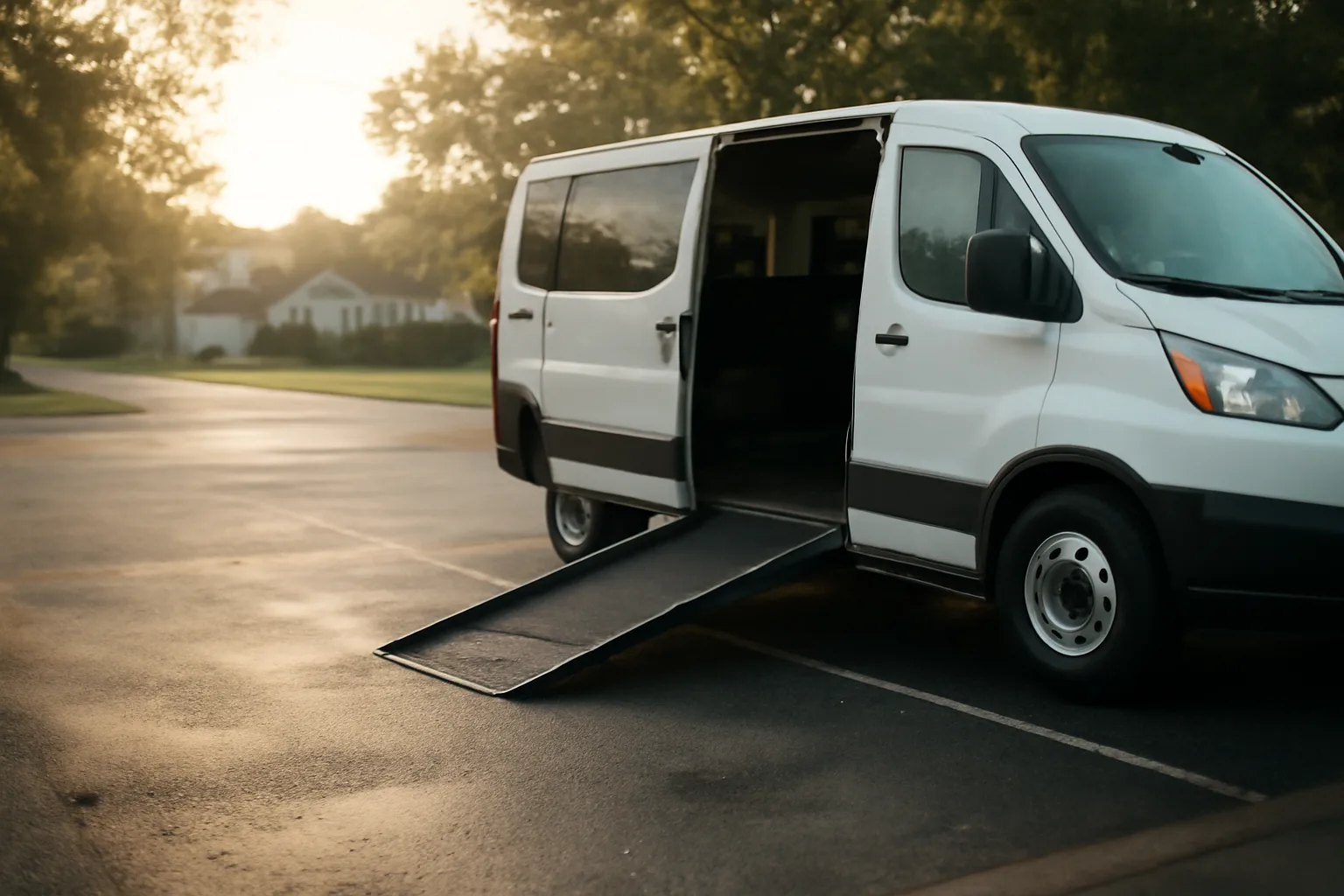
Non-emergency medical transportation is a Medicaid-covered benefit that gets people to and from medical appointments when they have no other way to get there and don't need an ambulance. Think dialysis three times a week, chemo, physical therapy, or a routine primary care visit for someone who can't drive and has no family nearby. Federal Medicaid rules require states to make sure eligible people can actually get to covered services. The regulation at 42 CFR 431.53 says states must "specify that the Medicaid agency will ensure necessary transportation for beneficiaries to and from providers" [1]. That's the legal root of NEMT: it exists because Medicaid has to guarantee access, more than pay claims. NEMT is not an ambulance. It's wheelchair vans, ambulatory sedans, and sometimes public transit vouchers or mileage reimbursement for a friend or relative who drives the person. No lights, no sirens, no clinical care en route beyond basic passenger assistance. That distinction matters enormously for insurance, because ambulance coverage sits under a completely different regulatory and underwriting world than NEMT. Most states contract this benefit out to a transportation broker (Modivcare, MTM, Access2Care, SafeRide Health, or a state-specific vendor) who screens, credentials, and dispatches trip work to independent NEMT providers and owner-operators. You don't bill Medicaid directly in most states; you get paid by the broker per completed trip. That's a separate topic covered in our nemt overview, but it's the backdrop for every insurance decision you'll make.
Does Medicaid cover ambulance rides, and is that different from NEMT insurance?
Yes, Medicaid covers ambulance transportation as a distinct benefit category from NEMT, and it carries different insurance and licensing requirements entirely. Ambulance services (basic life support, advanced life support, air ambulance) are billed under Medicare and Medicaid emergency transport rules, require EMT or paramedic staffing, and need commercial auto policies underwritten for emergency vehicle operation, which typically cost far more than NEMT wheelchair-van coverage. If you're buying a wheelchair van or ambulatory sedan to run Medicaid trips to dialysis and PT, you are not in the ambulance insurance market. Don't let an agent sell you an EMS-rated policy or make you carry EMS-level workers' comp classifications you don't need; it'll cost more and won't match what your broker credentialing packet actually asks for. Medicare's coverage of NEMT is much thinner than Medicaid's. Original Medicare generally does not cover routine non-emergency transportation to appointments; it covers ambulance transport only when medically necessary and under specific conditions described in the Medicare Benefit Policy Manual [2]. Some Medicare Advantage plans offer supplemental NEMT-like benefits, but that's plan-by-plan, not a Medicare-wide entitlement. If you're building a business plan around "Medicare pays for rides," stop: check the specific Medicare Advantage plan's supplemental benefit sheet before you count on it as a revenue source.
What insurance does a NEMT business actually need to carry?
| Commercial auto liability (combined single limit) | $500,000 to $1,500,000 per occurrence | Broker contract + state Medicaid transportation manual |
|---|---|---|
| General liability | $1,000,000 per occurrence / $2,000,000 aggregate | Broker contract |
| Physical damage (comp/collision) | Actual cash value of vehicle, insurer-set | Lender if financed, insurer |
| Workers' compensation | State statutory minimum, or proof required even if exempt | State labor/workers' comp agency + broker |
| Wheelchair lift/securement liability | Sometimes a named endorsement | Broker, ADA-related |
There are four coverages nearly every NEMT owner-operator ends up needing, though the exact limits vary by state and by broker: commercial auto liability, physical damage (comp and collision), general liability, and workers' compensation if you have any employees or if your state requires it for owner-operators too. Commercial auto liability is the big one. Your personal auto policy will not cover a vehicle used to transport paying passengers for a fee; that's a livery/for-hire use exclusion in nearly every personal auto contract. You need a commercial policy written for passenger-for-hire or livery use, and the limits Medicaid brokers require are almost always higher than your state's minimum financial responsibility law for a private car. A state might set personal auto minimums at $25,000/$50,000 for bodily injury, but a NEMT broker credentialing packet commonly asks for combined single limits of $500,000 to $1,000,000 per occurrence, sometimes $1,500,000 for larger wheelchair vans or multi-passenger vehicles. General liability covers non-auto exposures: a passenger who slips getting out of the van at your lot, or an injury during boarding/deboarding assistance that isn't strictly an auto claim. Many broker contracts ask for $1,000,000 per occurrence / $2,000,000 aggregate general liability in addition to auto. Workers' compensation rules are state-specific and depend on whether you have employees at all. If you're a true solo owner-operator with no employees, some states let you opt out of covering yourself, but plenty of broker contracts still require proof of either workers' comp or an occupational accident policy before they'll credential you, regardless of what the state technically mandates. Confirm this with both your state workers' comp agency and your broker; the two answers aren't always the same. Here's a rough shape of what shows up across broker credentialing packets and state Medicaid transportation manuals, though you must confirm the live numbers for your state and broker before buying anything: | Coverage type | Typical range seen in NEMT broker/state requirements | Who sets it |
How to start a medical transportation business, step by step
Starting a NEMT business generally follows a set order, and skipping steps almost always costs you more time later. Here's the sequence that actually works. First, form your business entity (LLC is standard for owner-operators) and get an EIN from the IRS. Second, get your state and any local business licenses; some states require a specific transportation network or livery permit separate from a general business license. Third, buy or lease your vehicle, making sure it's ADA-compliant if you're running wheelchair trips (secure tie-downs, ramp or lift, appropriate interior clearance). Fourth, get commercial auto insurance and general liability quotes before you finalize the vehicle purchase, because the vehicle type and age affect your premium significantly, and you want to know that number before you're locked into a loan. Fifth, apply for Medicaid transportation provider enrollment with your state Medicaid agency, which is a separate process from broker credentialing in most states. Sixth, apply for broker credentialing with whichever broker(s) run NEMT in your state, region by region, since Modivcare, MTM, Access2Care, and SafeRide each have their own packet, insurance certificate requirements, and vehicle inspection standards. Seventh, get driver background checks, drug testing, and any state-required NEMT driver training or certification done before you submit anything, because incomplete driver files are the single most common reason credentialing packets bounce back. Eighth, submit your Certificate of Insurance (COI) that names the broker as an additional insured, if that's required in your contract, matching the exact limits their packet specifies. Ninth, wait for state and broker approval, which can take anywhere from a few weeks to a few months depending on the state's Medicaid enrollment backlog and the broker's review queue; there's no reliable national average timeline, so ask your state Medicaid transportation unit for their current processing estimate. Our medical transportation overview walks through the state enrollment side in more depth, and nemt transportation covers broker-specific onboarding quirks.
How do you start a NEMT business with just one van?
One van is completely normal for a first NEMT business, and most owner-operators start exactly there. The insurance and licensing steps are identical whether you have one van or ten; what changes is your fleet policy structure and, in some states, whether you qualify as an "owner-operator" versus a "fleet" for broker contracting purposes. With a single vehicle, you'll typically buy a standalone commercial auto policy rather than a fleet policy, which can sometimes cost more per unit than a multi-vehicle fleet discount would, but it's still far cheaper in absolute dollars than insuring several vans. Ask your agent specifically about "livery" or "non-emergency medical transportation" class codes; some insurers lump NEMT in with taxi or limo classes, which can inflate your premium unnecessarily if your vehicle only does scheduled Medicaid trips rather than on-demand rides. Many brokers do let true one-van owner-operators enroll directly, but check this specifically. Some brokers in some states require a minimum fleet size or route capacity commitment that a single-van operator can't meet alone, in which case you might need to subcontract under an existing larger provider until you can add vehicles. This varies a lot by state and by broker, so confirm directly with the broker's provider relations team before you assume you can enroll solo. Don't skimp on the wheelchair lift/ramp maintenance and inspection paperwork just because you're small. Broker audits treat a one-van operator with the same vehicle inspection standard as a twenty-van company; there's no small-operator exception on safety compliance.
How to start a NEMT business: Medicaid enrollment specifics
State Medicaid provider enrollment for NEMT typically happens through the same portal used for other Medicaid provider types, but transportation providers usually need a distinct taxonomy code and sometimes a separate transportation-specific application supplement. CMS's Medicaid.gov describes NEMT as a benefit states must assure under federal regulation, but the actual enrollment mechanics (forms, fees, screening level) are entirely state-run [1][3]. Most states place NEMT providers in a "moderate" categorical risk screening level under the federal Medicaid/CHIP provider screening rule at 42 CFR 455.450, which can mean fingerprint-based criminal background checks and site visits, though the exact screening level is state-set and can change [4]. Confirm your state's current risk level with its Medicaid provider enrollment unit, since some states have moved transportation providers to "high" risk screening after fraud findings in specific markets. Expect an application fee in many states. CMS sets a federal Medicare/Medicaid/CHIP provider enrollment application fee that adjusts annually under 42 CFR 424.514; the amount for institutional providers revalidating or newly enrolling in calendar year 2025 is $737, published in the Federal Register notice announcing that year's fee [5]. Not every state charges NEMT providers this fee at the same rate, and some states waive it for certain provider types, so verify with your specific state Medicaid transportation unit before budgeting for it. After state enrollment, you still need broker credentialing in states that use a brokered model, which is the majority of states now. That's a separate insurance certificate submission, vehicle inspection, and driver file review, run entirely by the broker's own standards rather than the state's.
What does broker credentialing actually check for insurance?
Broker credentialing reviews your Certificate of Insurance line by line against their contract's minimum limits, checks that the broker (or the state, depending on the contract structure) is listed as an additional insured if required, and confirms your policy covers livery/for-hire passenger transport specifically, more than general commercial auto use. A COI that lists the wrong named insured, the wrong vehicle, or limits even slightly under the packet's stated minimum will bounce the whole application back, sometimes without much explanation beyond "insurance deficient." Get your agent to read the actual broker contract language, more than a summary you paraphrase to them, because the difference between "$500,000 combined single limit" and "$250,000/$500,000 split limit" matters to an underwriter and to the broker's compliance reviewer. Some brokers also require a specific endorsement for wheelchair lift or ramp liability, separate from general auto liability, especially in states where ADA-related lift injury claims have been a recurring issue. Ask specifically whether your broker's packet requires this endorsement by name; it's easy to miss because it's not always itemized as its own line on a standard COI template. Renewal timing trips people up constantly. If your policy renews mid-contract and you don't proactively send the broker an updated COI, you can get suspended from the dispatch platform even though you're still fully insured, just because their file shows an expired document. Set a calendar reminder 30 days before renewal, every year, permanently.
How much does NEMT insurance actually cost?
There's no single honest number here, because NEMT commercial auto premiums depend heavily on your state, your driving record, the vehicle type, how many vehicles you're insuring, and which insurer you land with; industry-wide public data on average NEMT premiums is thin and mostly comes from insurance brokers' own marketing rather than an independent published study, so treat any specific dollar figure you see online, including ours, as a rough planning range rather than a guarantee. What you can control: your driving record, your vehicle's age and safety features, and shopping multiple commercial auto carriers that specifically write livery/NEMT class codes rather than generic commercial auto. An insurer unfamiliar with NEMT sometimes prices it like a taxi or limo policy, which can run considerably higher than a policy written specifically for scheduled medical transport with no on-demand hailing exposure. Ask any quoting agent directly whether they've written NEMT-specific policies before, and ask for the exact class code they're using. If they can't answer that question specifically, get a second quote from an agent who specializes in transportation network or medical transport coverage. Budget for physical damage coverage too, more than liability, especially if you financed the van; most lenders require full comp/collision coverage as a loan condition, and wheelchair lift equipment itself can be expensive enough that you want it covered under an equipment or inland marine rider if your policy doesn't automatically include lift/ramp hardware in the vehicle's insured value.
What happens if you operate without proper NEMT insurance?
You'll get denied at broker credentialing, or worse, get pulled off the dispatch platform mid-contract if a routine audit finds your coverage lapsed or fell under the required limit. Beyond the contractual consequence, driving a passenger-for-hire vehicle without a commercial policy that covers that use means a personal auto claim can get denied entirely if you're in an accident while running a paid trip, since livery use is a standard exclusion on personal auto contracts. Some states also treat unlicensed or uninsured for-hire transportation as a separate regulatory violation outside of Medicaid entirely, enforced by a state's Department of Transportation or Public Utilities Commission rather than the Medicaid agency. That means you could face two separate enforcement tracks: a broker/Medicaid credentialing failure, and a state transportation regulatory citation, for the same underlying insurance gap. If you're ever audited and found to have billed the broker for trips run without valid coverage during that period, expect a payment clawback at minimum, and potential referral to the state's Medicaid fraud unit if the gap looks intentional rather than an honest lapse. This is not a corner worth cutting; the insurance premium difference between doing it right and doing it wrong is small compared to what a clawback or credentialing termination costs you in lost broker relationships.
How do the major NEMT brokers differ on insurance requirements?
Modivcare, MTM, Access2Care, and SafeRide Health each run their own contracted networks state by state, and none of them publish a single national insurance minimum that applies everywhere; the requirement is set contract by contract, often varying by state and even by the specific Medicaid managed care plan the broker is servicing in that region. What's consistent across all of them: they all require a current Certificate of Insurance before activating you on their dispatch platform, they all require the coverage to explicitly cover livery/for-hire medical transport (more than "commercial auto" generically), and they all run periodic re-verification, meaning your COI on file has to stay current or you get suspended, more than flagged. What varies: exact liability limits, whether general liability is required in addition to auto, whether a specific wheelchair lift/ramp endorsement is named, and whether workers' comp proof is required even for solo owner-operators with no employees. Don't assume that because you met Modivcare's insurance packet in one state, you automatically meet MTM's packet in a neighboring state, or even Modivcare's packet in a different state; these are separately negotiated contracts region by region. The most reliable move is to get the actual written credentialing packet from each broker you plan to work with in your specific state, hand it to your insurance agent directly, and have the agent quote to that document's exact language rather than to a general "NEMT insurance" request. For a broader look at how these brokers differ beyond insurance, see nemt transportation and non emergency medical transportation services.
Building the full launch checklist without missing a step
Between state Medicaid enrollment, broker credentialing, vehicle inspection standards, driver background checks, and insurance requirements, a first-time NEMT owner-operator is juggling four or five separate bureaucracies at once, each with its own forms, its own timeline, and its own definition of "complete." Missing one document type is the single most common reason applications sit in limbo for months instead of weeks. We built the $199 one-time State + Broker NEMT Launch Kit specifically because the state enrollment packet and the broker credentialing packet almost never ask for identical documents in identical formats, and reconciling that yourself, state by state and broker by broker, eats a lot of unpaid time before you've run a single trip. It's a reference tool to help you organize what to gather and in what order; it is not a guarantee of approval by any state Medicaid agency or any broker, and it doesn't replace direct confirmation with your state Medicaid transportation unit and your broker's provider relations team on current requirements. Whatever tool or checklist you use, the non-negotiable habit is this: before you submit anything, call or email your state Medicaid transportation unit and your target broker's provider relations contact, and get the current insurance minimums in writing. Requirements change; a figure that was accurate last year can be stale today. Confirm, don't assume.
Frequently asked questions
What is non-emergency medical transportation (NEMT)?
NEMT is a Medicaid benefit that transports eligible people to and from covered medical appointments, like dialysis or physical therapy, when they have no other way to get there and don't need ambulance-level care. Federal rule 42 CFR 431.53 requires state Medicaid agencies to ensure this access. It typically runs through wheelchair vans and ambulatory sedans, dispatched by a state-contracted broker.
Does Medicaid cover ambulance rides?
Yes, Medicaid covers ambulance transportation as a separate benefit from NEMT, generally when transport is medically necessary and other means would endanger the patient's health. Ambulance services require EMT/paramedic staffing and separate licensing and insurance from NEMT wheelchair-van providers. Confirm coverage specifics and prior authorization rules with your state Medicaid agency, since ambulance policy details vary by state.
Does Medicare cover medical transportation?
Original Medicare generally does not cover routine non-emergency transportation to appointments; it covers ambulance transport mainly in medically necessary situations, per Medicare's Benefit Policy Manual. Some Medicare Advantage plans offer supplemental non-emergency transportation benefits, but that's plan-specific, not a Medicare-wide guarantee. Check the exact Medicare Advantage plan's benefit summary before counting on it.
How to start a NEMT business from scratch?
Form your business entity and get an EIN, secure a compliant vehicle, get commercial auto and general liability insurance quotes, enroll as a Medicaid transportation provider with your state, get credentialed with your area's broker (Modivcare, MTM, Access2Care, or SafeRide), and complete driver background checks and training. Order matters: confirm insurance requirements before finalizing your vehicle purchase.
How to start a NEMT business with just one van?
One van is a normal starting point. You'll need a standalone commercial auto policy (not a fleet policy), state Medicaid provider enrollment, and broker credentialing. Some brokers set minimum fleet size requirements in certain states, so confirm directly with the broker's provider relations team whether solo owner-operators can enroll independently in your area before assuming you qualify.
What insurance does a NEMT owner-operator need at minimum?
At minimum: commercial auto liability written for livery/for-hire passenger transport (broker packets commonly ask for $500,000 to $1,000,000+ combined single limit), physical damage coverage if the vehicle is financed, and often general liability of $1,000,000/$2,000,000. Workers' comp rules vary by state and by broker; confirm both separately.
Will my personal auto insurance cover NEMT trips?
No. Personal auto policies almost universally exclude livery or for-hire passenger transport for a fee. Driving Medicaid NEMT trips on a personal policy risks a denied claim if you're in an accident during a paid trip, and it won't satisfy any broker's Certificate of Insurance requirement for credentialing.
What is the difference between state Medicaid enrollment and broker credentialing?
State Medicaid enrollment registers you as an approved Medicaid provider type, often through the same portal used for other provider categories, sometimes with a fee and background screening under 42 CFR 455.450. Broker credentialing is a separate process run by whichever broker (Modivcare, MTM, etc.) contracts NEMT dispatch in your state, with its own insurance, vehicle, and driver file review.
How long does it take to get NEMT insurance and credentialing approved?
There's no reliable national average; timelines depend on your state Medicaid agency's current processing backlog and your broker's credentialing queue, and can range from a few weeks to a few months. Ask your state Medicaid transportation unit for their current published processing estimate rather than relying on generic online timeframes.
Do I need a wheelchair lift endorsement on my insurance policy?
Some broker credentialing packets require a specific endorsement covering wheelchair lift or ramp liability, separate from standard auto liability, especially where ADA-related boarding injury claims are a recurring issue. This isn't universal. Check your specific broker's packet by name for this line item before assuming your standard commercial auto policy covers it automatically.
What happens if my NEMT insurance lapses mid-contract?
You risk suspension from the broker's dispatch platform even if the lapse was brief and unintentional, plus potential payment clawback for trips run during the uncovered period. In serious or repeated cases, brokers can terminate the contract and refer the matter to the state Medicaid fraud unit. Set a renewal reminder well before your policy's expiration date.
How do you start a medical transportation business step by step?
Form your LLC and get an EIN, obtain required business and transportation permits, buy an ADA-compliant vehicle, secure commercial auto and general liability insurance quoted to broker-specific limits, enroll with your state Medicaid agency, get broker credentialed, complete driver background checks, and submit a compliant Certificate of Insurance naming any required additional insureds.
Does every state use a NEMT broker like Modivcare or MTM?
Most states now contract NEMT through a broker, but not all, and some states run regional or county-level brokers instead of the large national names. Confirm which broker (or brokers) operate in your specific state and county directly with your state Medicaid transportation unit, since coverage areas and vendor contracts change over time.
Sources
- eCFR, 42 CFR 431.53: States must ensure necessary transportation for Medicaid beneficiaries to and from providers
- CMS, Medicare Benefit Policy Manual, Chapter 10 (Ambulance Services): Medicare covers ambulance transport under specific medical necessity conditions rather than routine non-emergency transportation
- Medicaid.gov, Non-Emergency Medical Transportation: NEMT is a required Medicaid benefit ensuring access to covered medical care
- eCFR, 42 CFR 455.450: Medicaid provider screening risk levels (limited, moderate, high) determine background check and site visit requirements
- eCFR, 42 CFR 424.514 (Application fee): CMS requires an annually adjusted application fee from institutional providers, including certain transportation provider types, upon initial enrollment and revalidation
- 42 U.S.C. 1396a(a)(70) / Social Security Act Section 1902(a)(70), NEMT broker option: Federal Medicaid law allows states to contract with a broker to arrange non-emergency medical transportation under a competitively bid contract
- eCFR, 49 CFR 387.9 (Financial responsibility, minimum levels for for-hire motor carriers): Federal minimum financial responsibility levels for motor carriers transporting passengers for hire set a regulatory floor distinct from ordinary personal auto minimums